DRISHTI · INTRODUCTION
The Shape of a Doubt
We learned to measure a planet long before we learned how to live with what we could not predict.
EARTHVISION LAB · ~7 MIN READ
THE OLD QUESTION
This is not an argument that we have failed to understand Earth, nor a claim that we have succeeded. It is an attempt to surface a doubt.
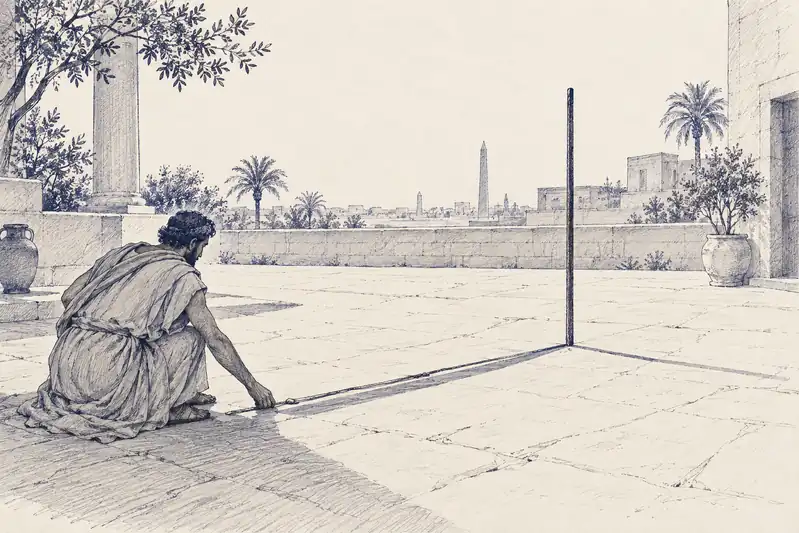
I keep coming back to Eratosthenes. Around 240 BCE, he measured the circumference of Earth with two sticks, two shadows, and the distance between Alexandria and Syene. The answer was not perfect. It did not need to be. It was close enough to make the story uncomfortable: a person standing on the ground, with almost no machinery, understood something planetary.
More than two millennia later, Lewis Fry Richardson tried to calculate the atmosphere itself. In 1922 he published Weather Prediction by Numerical Process after using a gridded mathematical method to produce a six-hour forecast by hand. The calculation took more than six weeks and the forecast was wrong, but the method survived. In 1950, Jule Charney, Ragnar Fjørtoft, and John von Neumann used ENIAC to show that numerical weather prediction could work when computation finally caught up with the idea.
The viewpoint widened. TIROS-1 in 1960 made systematic weather observation from orbit practical. Landsat 1 in 1972 turned the land surface into a repeated multispectral record. GOES-1 in 1975 held a fixed view over the hemisphere and gave forecasters near-real-time observations of changing weather. Each step made a different part of Earth easier to observe, compare, or anticipate.
Commercial systems then pushed the same idea further. WorldView-1 in 2007 and WorldView-3 in 2014 increased the detail available from orbit, including imagery later used routinely for mapping and disaster response. Descartes Labs, founded in 2014, pursued a different layer of the problem by combining satellite, weather, and other geospatial data with large-scale computation and machine learning. In 2017, Planet announced that it had achieved its founding mission of imaging the entire landmass of Earth every day.
Prediction moved again in 2023 when GraphCast used a graph neural network to generate global ten-day weather forecasts faster than conventional numerical systems and outperformed ECMWF's operational deterministic HRES system on most of the variables and lead times evaluated. ECMWF then put its own Artificial Intelligence Forecasting System into operations in 2025, followed by a 51-member ensemble version, and in May 2026 moved both operational AIFS systems to version 2.
None of this forms a clean story of success or failure. Richardson's forecast failed and helped establish a field. Satellites succeeded at seeing what could not be seen from the ground. Daily constellations reduced the time between observations. Learned models improved prediction without making the atmosphere simple. The more capable the machinery became, the less useful it was to ask only whether it worked. A harder question remained underneath: what, exactly, had been understood?
MORE OBSERVATION
The planet became measurable
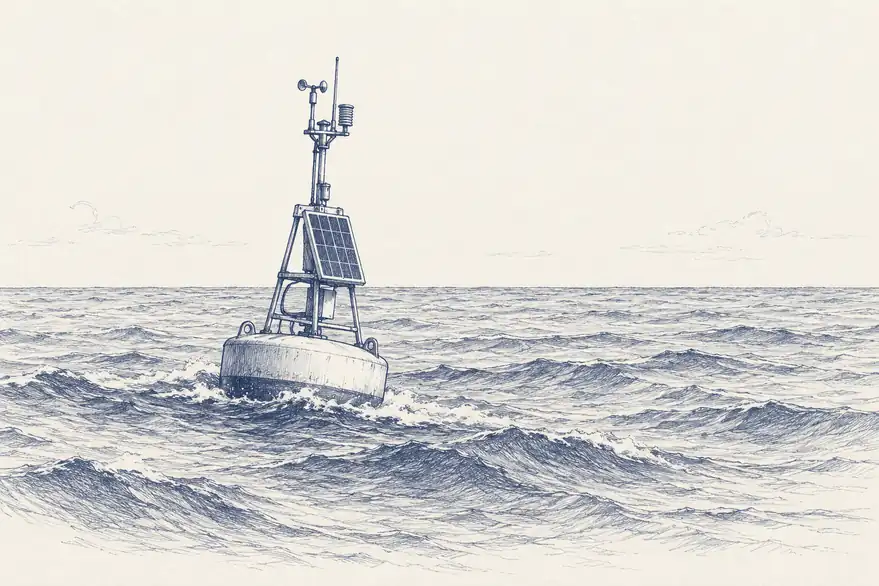
Today Earth is surrounded by instruments. Satellites, weather stations, buoys, aircraft, ships, phones, ecological sensors, and infrastructure systems continuously produce evidence that something happened somewhere. We can measure the planet at a scale no earlier civilization could have imagined.
That achievement is real. It is also where the harder question begins. A measurement can be precise without explaining a mechanism. A model can be accurate without being useful for the decision in front of someone. A warning can arrive and still fail if nobody knows what to do with it.
More observation gives us more chances to know. It does not guarantee that we know what the observations mean.
THE QUESTION
What would count as understanding?
I use the word understanding cautiously. It cannot mean perfect prediction, because Earth does not offer that kind of certainty. It has to mean something more practical: knowing enough about relationships, history, uncertainty, and possible futures that an observation can support a better decision without pretending to know more than it does.
You can observe a person repeatedly, record them in extraordinary detail, and still not truly understand them. Earth asks the same thing of us.
We have spent decades increasing the fidelity of our view. More satellites. More sensors. More measurements. More models. More data. More frequent updates. More AI.
But perhaps we are still looking at Earth from the outside. We can describe what changed. We can reconstruct what happened. We can estimate what may happen next. But understanding is a different claim.
To understand something is not merely to possess more information about it. It is to grasp how its parts relate, why it behaves as it does, what matters, what does not, what can change it, and what remains hidden even after measurement.
Perhaps the planet is not a puzzle waiting for enough data. Perhaps every new layer of observation reveals another layer beneath it.
The atmosphere affects the soil. The soil affects the plant. The plant changes the atmosphere. Water connects landscapes. Infrastructure changes water. Markets change land use. Human decisions alter ecosystems. Ecosystems alter climate. Nothing remains neatly inside the boundary of the discipline studying it.
So where does understanding actually live? In the satellite image? In the sensor? In the model? In the relationships between them? In the history of the place? In the person standing on the ground? Or in something larger that none of these can hold alone?
The doubt is whether an increasingly complete description of the planet eventually becomes understanding, or whether understanding requires something fundamentally different.
The volumes that follow test that question across observation, planetary memory, prediction, machine intelligence, and the places Earth remains difficult to see. They are not variations of one answer. They are different places where the boundary between seeing and knowing becomes visible.
The planet is measurable. The question is what, if anything, that allows us to understand.