DRISHTI · CHAPTER 4.4
Can We Compute Something Alive?
A tree takes a century to grow and an afternoon to fall, an animal needs a route as well as a habitat, and a harvest becomes a price before it becomes a meal.
EARTHVISION LAB · ~15 MIN READ
MODELLING LIFE
Water obeys gravity and has no opinions. Living things are less cooperative. Trees compete, store carbon, shut their pores in a drought, reproduce, die and change the light and moisture available to everything around them. Animals decide where to go. Crops are planted on dates chosen by people who read the forecast. The thing being predicted keeps changing the conditions of its own prediction.
Forecasting life therefore uses a different kind of mathematics at each step. Forests are modelled as populations of trees. Species are modelled as preferences for climate. Crops are modelled as a plant stepped through a season, and food as a chain that runs from the plant to a market, a road and a household budget.
Each model is respectable on its own. What makes this territory instructive is that the uncertainty does not stay the same kind of uncertainty as it moves along the chain. It starts as biology and finishes as politics.
GROWTH AND DISTURBANCE
A forest runs on several clocks
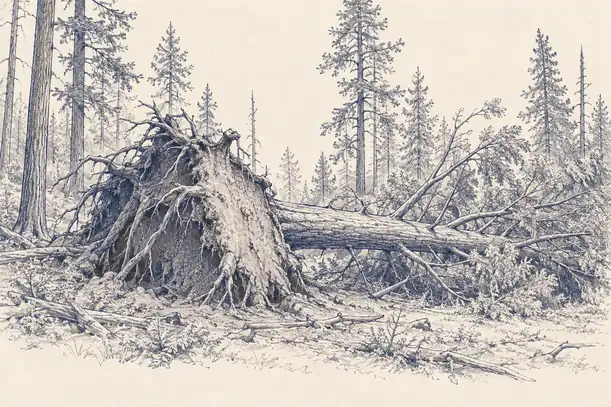
A tree may take a century to grow and minutes to fall. Soil carbon can turn over for centuries while a fire resets a stand in an afternoon. Detailed forest models represent trees individually or as cohorts grouped by size, age or type, simulate their competition for light, water and nutrients, and update growth, recruitment and death through time. Succession emerges from those interactions rather than being written in as a fixed sequence. Two stands with similar canopy cover can have very different futures if one is full of young fast-growing trees and the other of mature, drought-sensitive ones.
Death is the difficult term. Growth follows reasonably well-studied physiology. Death arrives through drought, insects, pathogens, wind and fire, often in combination. Fire, windthrow and outbreaks are usually attached to vegetation models as separate modules because they run on different scales, which is practical and slightly dangerous: fuel depends on the forest's history, fire changes what regrows, drought weakens trees before the beetles arrive, and dead trees become fuel. The modules are separate in the software and coupled in the forest.
Carbon forecasts inherit the problem. A forest's long-term balance can be set by growth in ordinary years and by disturbance in one extraordinary year, so a model can estimate average productivity well and still miss the event that decides the decade. The useful output is therefore rarely one forest in 2100. It is a range of forests under different climates, disturbance regimes and management choices. Trees have enough uncertainty without being given one official future.
Scale makes a final demand. A model detailed enough to track individual trees cannot run globally at a useful speed, so Earth-system models compress vegetation into broad plant functional types and lose much of the demography that controls local mortality. Plot models know trees. Global models know fluxes. Regional prediction lives in the uncomfortable space between them, where both kinds of knowledge are needed and neither fits.
WHERE WILL THE ANIMALS GO?
Suitable is not occupied, and occupied needs a route
The common way to forecast where a species will live is to learn the climate at the places it is found now, then look for those conditions on a future map. Temperature rises, rainfall shifts, and the map produces a new area labelled suitable. The species is not consulted. Ecologists distinguish the fundamental niche, the conditions an organism could tolerate, from the realised niche, the smaller set it actually occupies after competitors, predators and history have had their say. Most records describe the second, so a model can mistake an old absence for a physiological limit, and project a range that is too narrow, or a broad one the animal can never reach.
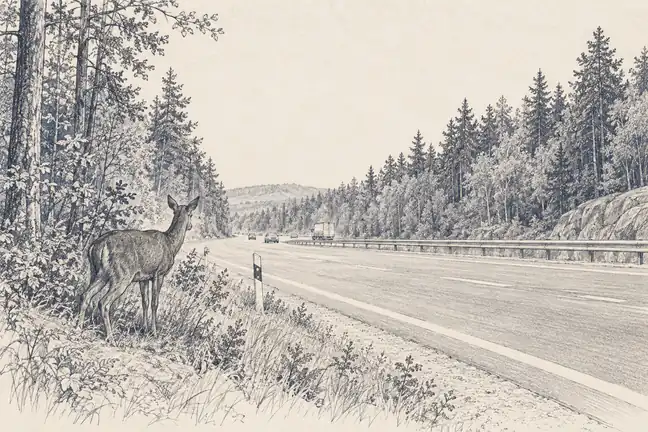
Movement models add the missing route. They estimate how animals respond to terrain, roads, settlements, water and vegetation as they move, then test whether individuals can actually reach the future habitat. The answer often depends less on climate than on a motorway, a fence or a gap between protected areas. Speed matters too. Climate velocity describes how fast a set of conditions moves across a landscape, and if suitable climate moves uphill faster than a population can follow, the future habitat exists in the model and nowhere else.
At sea the geometry gets stranger. A feeding ground may be a temperature front or a bloom that moves every week, so predicting the animal means predicting the moving feature first. Habitat stops being a place and becomes a condition.
Range forecasts are also unusual in that they change the world before they can be checked. Reserves are designed, corridors restored and threat assessments written on the strength of them, years before the animals move. That makes comparison more defensible than prophecy. A model may be poor at saying where a species will live in 2080 and still good at saying which of two corridors stays useful across several climate futures, which is the question the people buying the land actually needed answered.
CROP MODELS
A plant can be simulated before it is harvested
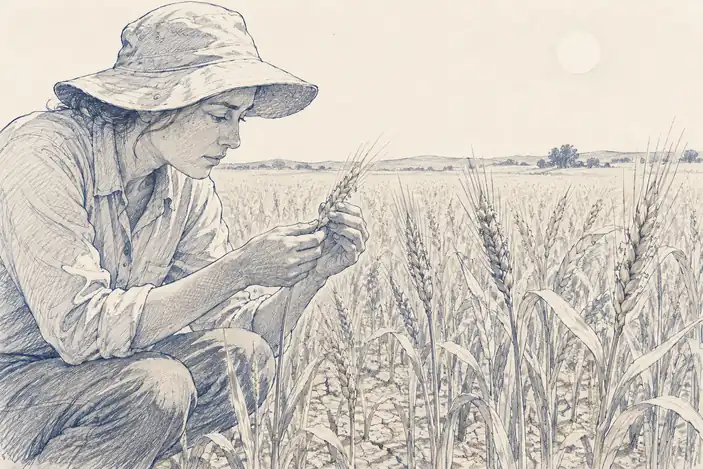
Process-based crop models such as DSSAT simulate a plant's progress through its developmental stages while accounting for weather, soil, water, management and the characteristics of the particular variety. They do not predict yield by recognising a familiar picture. They step a simplified plant through a season and see what it makes of it.
Timing is decisive. Heat or water stress during flowering or grain filling can matter far more than the same stress two weeks earlier. A season's rainfall total can look entirely normal while yield falls, because the right amount of weather arrived at the wrong moment.
The practical difficulty is that a global forecast cannot know every variety, sowing date, irrigation schedule or soil profile. Operational systems therefore blend crop models, weather forecasts, satellite observations, field reports and statistical corrections into one outlook. The plant is biological. The forecast is diplomatic.
MARKETS AND ACCESS
A harvest becomes a price before it becomes a meal
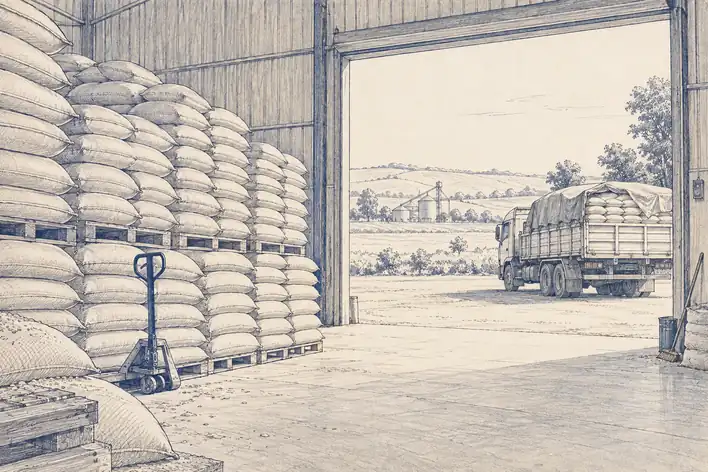
Once the harvest is in storage, the problem becomes economic. A regional shortfall can be absorbed by stocks or imports. A perfectly normal harvest can coexist with rising food prices if a currency weakens, transport costs rise or trade is disrupted. Tonnes of grain and access to food are related variables, not synonyms.
FAO's Global Information and Early Warning System is built around that fact. It tracks production, consumption, trade, prices and food-security conditions rather than treating crop output as the answer, in forward-looking reports on crop prospects and in a Food Outlook that follows global commodity markets. Its forecasts are conditional by design: given this production, these stocks, these import routes and these prices, what happens next? Change one border rule and the crop forecast stays correct while the food outcome changes.
Further down the chain, humanitarian early-warning systems have to estimate whether households can actually obtain food, from prices, conflict, displacement, rainfall, vegetation, market access and surveys gathered in difficult places. The further a forecast travels from the field, the less physics can do for it. A weather model predicts from equations. A food-security outlook combines evidence and scenarios, updates often, and has to admit that a blockade can undo yesterday's assessment in an afternoon.
That is the particular lesson of living systems. A chain can be forecastable at every link and still be hard to forecast from end to end, because the uncertainty does not merely add up as it travels. It changes form, as biology becomes logistics, logistics becomes economics and economics becomes a decision somebody makes.