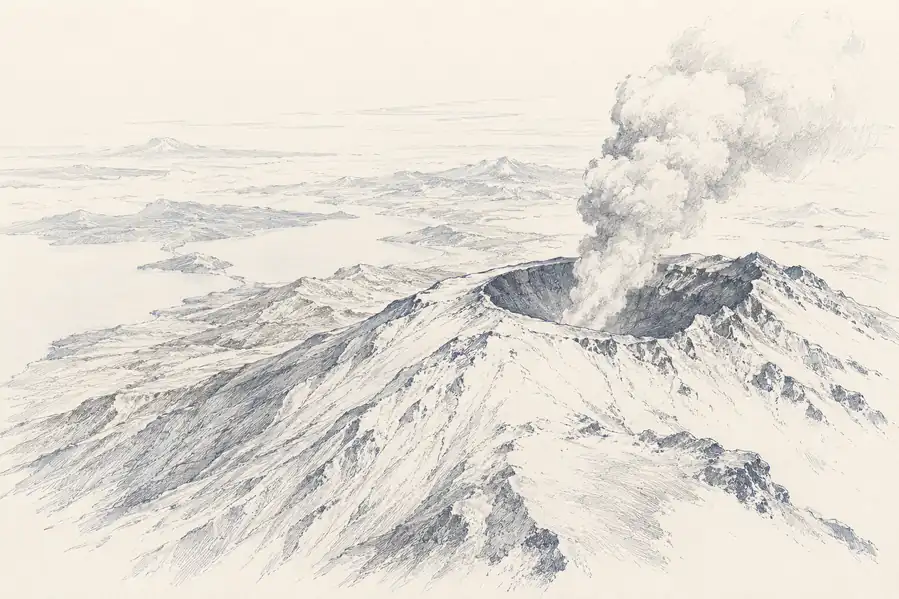
DRISHTI · CHAPTER 5.5
The Machine Found a Pattern, Then Asked to Look Again
Planetary data is full of convincing coincidences. The useful machine tests them, and then tells a satellite where to point next.
EARTHVISION LAB · ~18 MIN READ
DISCOVERY
A planetary dataset can hold weather, vegetation, water, movement, prices, infrastructure and human activity across decades. The number of possible relationships among those variables is far larger than any research community could inspect by forming one hypothesis at a time and waiting for a grant.
Machine learning can search that space cheaply. This sounds like automatic discovery until the first statistical problem arrives: with enough variables, the machine will discover relationships that are perfectly real in the dataset and completely useless in the world.
Prediction and explanation reward different things. A variable can improve a forecast without causing the outcome, and a model can exploit it happily for years and fail the moment the relationship changes. Discovery asks for more than usefulness. It asks whether a relationship survives an honest attempt to explain it away, and, when it does, what should be measured next.
THE FALSE-DISCOVERY PROBLEM
Earth is exceptionally good at convincing coincidences
Seasons are the first trap. Temperature, vegetation, electricity demand, animal activity, river flow and a great many economic habits all change through the year. Two of them can follow each other beautifully because both own a calendar, not because either affects the other.
Neighbours are the second. Nearby pixels, stations and communities are not independent samples. A map of a million cells does not contain a million independent pieces of evidence if neighbouring cells share climate, soils, infrastructure and history, and the effective sample size can be far smaller than the row count suggests.
Common drivers are the third. Two distant variables can move together because both respond to a large climate pattern such as El Niño. A lag makes the link look even more persuasive: one changes first and the other follows. Order in time is necessary for causation and nowhere near sufficient.
Then there is arithmetic. Test enough candidate relationships and some will look strong by chance. Statistical corrections control part of this, but planetary data adds complications the textbook version leaves out: autocorrelation, hidden common causes, irregular sampling and changing regimes. More data does not abolish false discovery. It gives false discovery better infrastructure.

CAUSAL DISCOVERY
Conditioning, and the Walker circulation
A 2019 Nature Communications paper by Jakob Runge and colleagues showed the problem with a compact climate example: pressure and temperature variables tied to the Walker circulation, the great east-west loop of air over the tropical Pacific. Simple correlations and pairwise Granger-causality tests produced dense networks full of links. That is unsurprising. Climate variables share persistence and common drivers, so nearly everything predicts something else when examined two at a time. The graph was statistically busy and physically indefensible.
Their PCMCI method works in two stages. It first picks candidate causes for each variable, then tests whether a proposed link survives once the relevant past of the other variables is taken into account. In the Walker example it recovered a much sparser network, much closer to the known physics. That is the honest job of causal-discovery machinery. It does not turn observational data into an oracle. It asks whether a link survives once the obvious alternatives are accounted for, and most links turn out to have been introduced by the rest of the system.
The method has assumptions of its own. Hidden common causes are normal on Earth, because no network measures every process that matters. Many processes interact faster than they are sampled, so daily data cannot say which of two variables moved first within the hour. And relationships drift: a link stable for thirty years can weaken after a reservoir is built or irrigation spreads. This is where physics earns its keep in data-driven discovery. Conservation laws, known timescales and impossible directions can rule out candidates before statistics is asked to judge them. The model searches. Physics decides which parts of the search deserve respect.
Realistic machine discovery is therefore a loop. A model surfaces an unexpected relationship, statistics removes the artefacts, domain knowledge removes the implausible, and what survives becomes a hypothesis rather than a conclusion. The next question is unusually concrete: what evidence would tell the remaining explanations apart? A different variable, a contrasting location, a passing event that acts as a natural experiment. Discovery becomes a matter of choosing the next observation, and a system that can choose observations has started to influence the observing system itself.
Finding an unexplained relationship is not the end of discovery. It is the moment the system earns the right to ask a better question.
CLOSING THE LOOP
A satellite looked ahead and changed its own plan
Most Earth observation has run on a schedule: pass over a place, collect what was planned, send it down, process it, decide whether anything interesting happened, then request another look later. The planet is permitted to change while the paperwork catches up. That is fine for a glacier and hopeless for a wildfire, a volcanic plume, a flash flood or a methane release, where the useful observation may exist for minutes. A closed-loop system changes the order: it observes, interprets enough to decide whether the observation matters, and changes what it collects next.
The idea flew before modern deep learning existed. NASA's Autonomous Sciencecraft Experiment began operating on the Earth Observing-1 spacecraft in 2003, combining onboard event detection, planning and execution so the spacecraft could notice volcanic activity, flooding or changing ice and adjust what it observed or sent home first. The classifier was modest. The architecture was the point: a science result could alter the spacecraft's next action without waiting for the ground. Latency changes the value of inference, and a mediocre classifier that acts within seconds can beat a brilliant one whose answer arrives after the spacecraft has crossed the horizon.
In 2025 NASA JPL's Dynamic Targeting experiment showed the modern version aboard the commercial CogniSAT-6 spacecraft. It looked ahead along its own ground track, analysed the imagery onboard for cloud, planned where a clear view would be available, and repointed its instrument before arriving, all in under 90 seconds and with no human involved. A satellite in low orbit covers several kilometres every second, so by the time an image reached the ground and a new command came back, the scene would be far behind it. Cloud avoidance is deliberately ordinary: optical missions spend a large share of their capacity photographing the tops of clouds. The same loop can be pointed at storms, eruptions and fires.
More interpretation is moving beside the instrument. ESA's Φsat-2, a 6U CubeSat launched on 16 August 2024, carries six onboard AI applications for cloud detection, wildfire and vessel detection, street mapping and image compression, fed by an eight-band camera at about five metres over a swath roughly 20 kilometres wide. It still calibrates, aligns and geolocates its images before running them, because a model in orbit is still a remote-sensing model. Together with Prithvi's run in orbit, it describes a continuum: filter out the useless, prioritise the unusual, then retask. The hardware can be identical at every step. The consequences of a mistake are not.
THE CONTROL PROBLEM
An observing policy can create its own blind spots
Once a model controls observation, its misses get more serious. A classifier that overlooks an event after it has been photographed produces a wrong label. A classifier that decides an event is uninteresting before the image is taken can erase the very evidence that would have exposed the mistake.
There is a feedback loop hidden in this. If a system preferentially observes what it already recognises, its future training data fills up with familiar events and runs short of unfamiliar ones. The observing policy quietly shapes the dataset used to improve the observing policy. A curious machine can become conservative without anyone ever programming caution.
A robust policy therefore balances exploitation with exploration. Some capacity follows high-confidence events because they are valuable; some goes to uncertain or novel scenes because the model may be wrong about them. Active learning applies the same principle to labelling: ask for the examples expected to teach the most, not another easy one.
The larger design is cooperative. One spacecraft detects a thermal anomaly and another, better suited, images it at high resolution; a radar observation asks for an optical follow-up when the cloud clears. Intelligence lies in allocating attention across a network rather than making each satellite individually clever. That allocation depends on a faculty the system has so far been assumed to have: knowing when its own evidence is weak. Without it, autonomous observation is merely a faster way of acting on confidence that may not deserve it.
A sensor becomes part of an intelligent system when an observation can change what gets observed next.