DRISHTI · NOTE 002.5
Everyone Is Watching Now
Launch got cheap enough to lose satellites on purpose, and a hobby got organised enough to count a continent's birds. Watching stopped belonging to governments.
EARTHVISION LAB · ~5 MIN READ
CROWDS
In 1972, every satellite operator on Earth was a government, because only a government could afford to lose one. What changed by the 2010s was not that satellites got better. It was that losing one stopped being expensive enough to end a company.
That single change let a business do what no government program would risk: build satellites quickly, launch them by the dozen and learn by losing some. At the same time, and with no rocket involved at all, the oldest kind of watching, ordinary people noticing things, got organised on a scale Frank Chapman's 27 bird counters could not have pictured. Observation became plural.
THE DOVE MODEL
Satellites built to be lost
Reusable rockets did most of the work. By flying the same Falcon 9 booster again and again, SpaceX removed the largest hardware cost from each launch, and small satellites began riding along in shared launches. By early 2026 a rideshare seat to sun-synchronous orbit cost about $350,000 for the first 50 kilograms plus $7,000 for each kilogram after, which is a loss a company can absorb and still open on Monday.
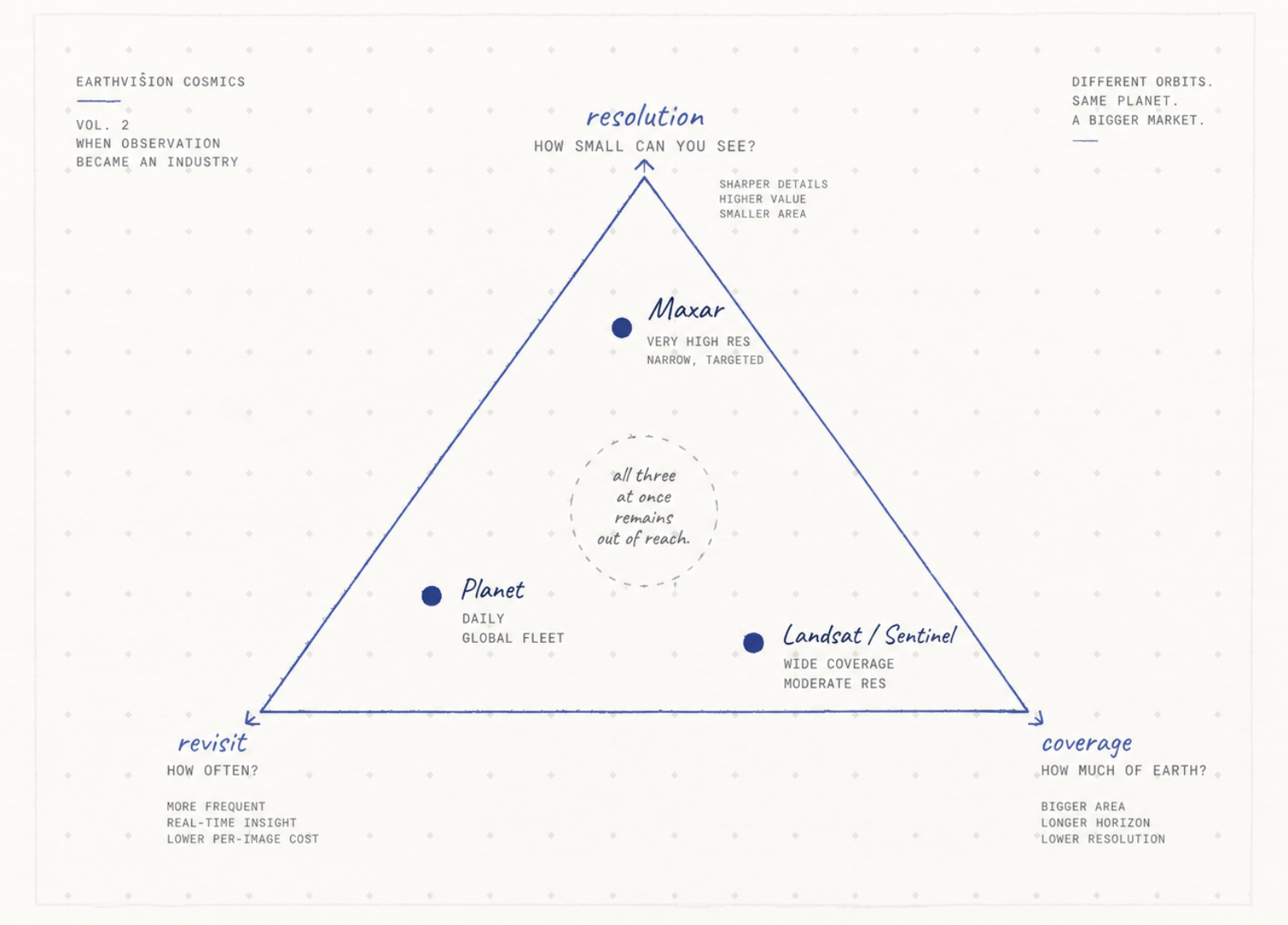
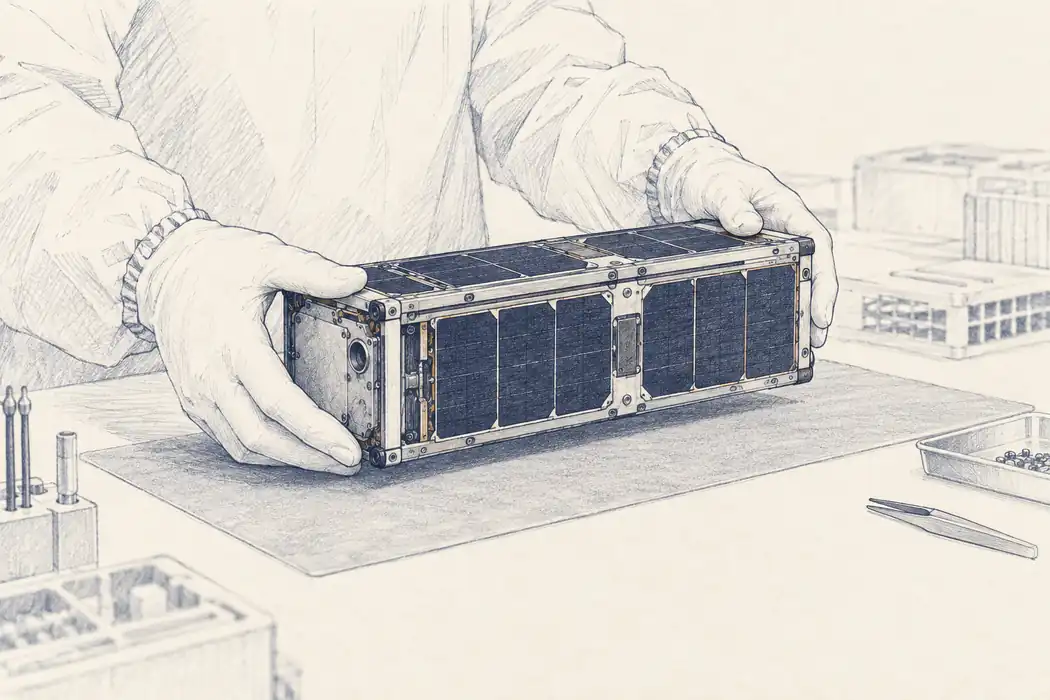
Planet Labs, founded in 2010 by three former NASA scientists, built its satellites to that arithmetic. Each Dove was a 3U CubeSat, roughly the size of a loaf of bread, and 28 of them deployed from the International Space Station in February 2014. A government mission costing hundreds of millions cannot be allowed to fail, so every part gets a backup and years of testing. A Dove could simply fail, and the flock carried on one Dove lighter. That tolerance is how Planet reached the daily imaging of all Earth's land that The Shape of a Doubt dated to 2017: not with a better satellite but with enough cheap ones that losing some stopped mattering.
You can't fix what you can't see. We want to give people the tools to see change and take action.Will Marshall, co-founder, Planet Labs
Others spent the same savings differently. Maxar's WorldView Legion satellites, the first pair launched in May 2024, see detail down to 30 centimetres, enough to tell one type of vehicle from another. The Finnish company ICEYE launched a 70-kilogram radar satellite in January 2018, the first under 100 kilograms, and grew it into a fleet of more than 80, with Capella Space and Umbra building similar ones, until the U.S. National Reconnaissance Office began buying radar pictures from all three. Corona's descendants had become customers.
The product changed along with the hardware. BlackSky pairs a constellation of small optical satellites with software that promises a place will be revisited on schedule and a fresh picture delivered within hours. The customer is buying not an image but a subscription to a location being watched, a service that in 1965 would have required a security clearance and in 2026 requires a credit card.
EVERYONE WITH BINOCULARS
The crowd came back, with better notebooks
While the sky filled with satellites, the ground filled with observers. The Christmas Bird Count that began with 27 people in 1900 held its 126th count in the winter of 2025 to 2026, with tens of thousands of volunteers across the Americas. It is still counting in largely the same way, which is exactly why its century of data is worth so much.
eBird, launched in 2002 by the Cornell Lab of Ornithology and the National Audubon Society, turned the rest of the year into a count. A birdwatcher records which species they saw, where, when and for how long they looked, and the list joins those of every other birdwatcher on the planet. The last detail matters more than it seems: recording how long someone looked lets scientists tell a rare bird from a brief glance. What had been a private notebook became one of the largest biodiversity records ever assembled, collected mostly by people doing it for pleasure.
The crowd now watches more than birds. People photograph plants and insects for identification, report floods and earthquakes from their phones, and read rain gauges in their gardens for national networks, much as Korea's districts reported their bronze buckets six centuries earlier. None of these observers is as precise as a satellite. All of them are somewhere a satellite is not: under the canopy, at eye level, on the day it happened, able to say what a thing actually was.
PLURAL
A planet watched from every direction at once
The two new kinds of watcher run on different fuel. Government records like Landsat are funded years ahead, with the next satellite built before the current one fails. Commercial fleets run on revenue, and several operators, Planet among them, have been through lean years and restructuring. Crowds run on enthusiasm, which is surprisingly durable but goes where people go. Each is strong exactly where the others are weak, which is why the planet now keeps all three.
Put together, the result would have astonished anyone from the ground era. On an ordinary night in May, public satellites pass over every continent, private fleets revisit their customers' fields and ports, weather radars built for rain map the birds migrating through the dark, hydrophones listen to whales across an ocean basin, Mauna Loa logs another reading of the air, and tens of thousands of people write down what they saw that day. Torricelli could weigh the sky over one room. The planet is now weighed, photographed, heard and counted continuously, from orbit to the garden fence.
Each of those watchers keeps its own record, in its own units, on its own schedule, for its own reasons. A radar reports reflectivity, a birdwatcher reports a species, a satellite reports reflectance in a pixel, a tag reports a position every hour. For the first time in history, the difficult part of knowing the planet was no longer getting a view of it. It was getting all those views to describe the same world in the same language.