DRISHTI · NOTE 002.1
Mercury, Rain and a Starling Called VIBORG 1
For three centuries, watching Earth meant standing on it. The instruments were brilliant. The view was a scatter of dots.
EARTHVISION LAB · ~7 MIN READ
ON THE GROUND
The Shape of a Doubt credited Eratosthenes with two sticks and Lewis Fry Richardson with six weeks of arithmetic. Neither was short of intelligence. What limited both was where a person could stand, and for most of history the answer was: on the ground, in one place, looking at whatever happened to be nearby.
Within that limit, people built astonishing instruments. Between the 1440s and 1930 they worked out how to weigh the air, how to send a weather report faster than the weather, how to put an address on a bird and how to post a thermometer into the sky on a balloon. Three ideas came out of that period, and every observing system since has inherited them: measure something invisible by its effect on something visible, collect readings from many places at the same moment, and attach a label to a living thing so that it reports back on its own.
WEIGHING THE INVISIBLE
Air turned out to have weight
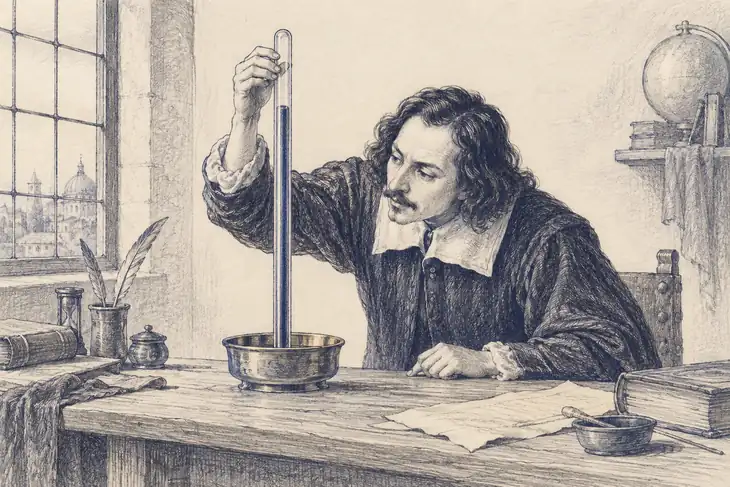
In 1643 Evangelista Torricelli filled a glass tube with mercury, turned it upside down in a dish, and watched the column settle at about 76 centimetres with an empty space above it. Something was holding up that column, and the only candidate was the air pressing on the mercury in the dish. The air, in other words, had weight, and the tube was weighing it. Over the following days the column rose and fell, which meant the weight of the sky above a single room in Florence was changing, and nobody had noticed.
Blaise Pascal reasoned that if air had weight, there should be less of it on top of a mountain. On 19 September 1648 his brother-in-law, Florin Périer, filled two tubes with mercury in a monastery garden at the foot of the Puy de Dôme in central France, left one there with a monk to watch it, and carried the other up the mountain. At the summit the column stood more than 8 centimetres lower. The monk's column, meanwhile, had not moved all day. It remains one of the best-designed experiments ever conducted by a family member on a day out.
That was the first great trick of observation: measure something you cannot see by the effect it has on something you can. A falling barometer came to mean an approaching storm long before anyone understood why, and sailors trusted it the way they trusted nothing else on board. Daniel Gabriel Fahrenheit's mercury thermometer of 1714 extended the trick to heat, and its real achievement was modest and enormous at once: two of his thermometers, built to the same design, gave the same reading in the same place.
Rain had been measured longer than either. In 1441, under King Sejong of the Joseon dynasty, Korea distributed standard bronze rain gauges, the cheugugi, to administrative districts across the kingdom, so that rainfall in one province could be compared with rainfall in another, a matter of real interest to a state that lived on its harvests. The instrument was a bucket. What made it remarkable was that every district had the same bucket, which is a sentence that describes most of the history of measurement.
By the nineteenth century, then, a curious person could weigh the air, read its heat and catch its rain with real precision. Each reading was excellent and each was a single point: the weather over one roof, measured beautifully, with no idea what was happening over the next hill.
MANY PLACES AT ONCE
The weather report learned to outrun the weather
One reading tells you the weather where you are. Two readings taken at the same moment tell you something new: a difference in pressure between two towns, which is the beginning of wind, and a direction in which the weather is travelling. The obstacle was that readings moved by horse and ship, and storms moved faster. A network of stations could produce a very good history of the weather and never a picture of it happening.
The sea solved half of this first. In 1853 the U.S. Navy officer Matthew Fontaine Maury brought the maritime nations together in Brussels to agree a single format for ships' weather logs, and cooperating vessels began recording wind, pressure and sea temperature in the same way and handing the logs in at the end of the voyage. Every merchant ship became a floating observer that happened to be going somewhere else. The results were still weeks old, but for the first time the open ocean had a pattern rather than a rumour.
The land half took a disaster. On the night of 25 October 1859, a storm with gusts near 100 miles per hour tore across the Irish Sea. It sank or wrecked more than 200 ships, among them the Royal Charter, a steam clipper returning from Australia, which went down off Anglesey with more than 450 people aboard. Robert FitzRoy, formerly captain of HMS Beagle and by then head of Britain's new meteorological department, went through the readings afterwards and showed that the storm's approach had been visible in them. It had simply been visible in too many separate places to be seen at once.
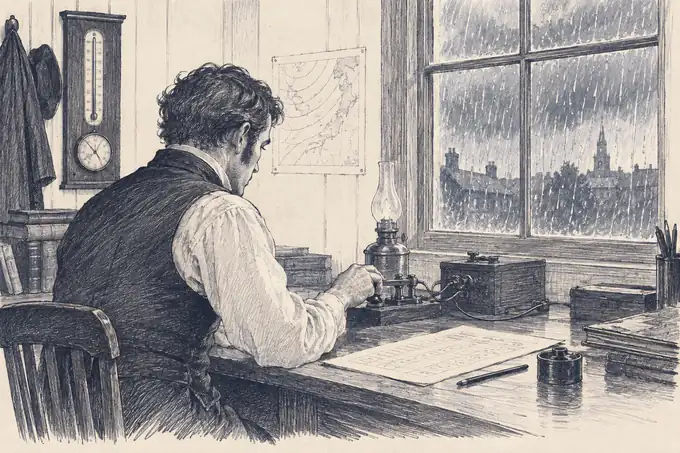
The telegraph solved that. From 1860 FitzRoy had observers around the coast telegraph their morning readings to London, where they were copied by hand onto a single sheet. In February 1861 he began hoisting canvas cones on harbour masts to warn ships of approaching gales, and on 1 August 1861 The Times printed the result on page 10: the world's first public weather forecast, a term FitzRoy coined for the purpose. For the first time, the report was travelling faster than the weather it described.
The next move was upward. On 30 January 1930, at Pavlovsk near Leningrad, Pavel Molchanov released a balloon carrying a small instrument that radioed its readings back in Morse code as it climbed, reaching 7.8 kilometres and reporting -40.7°C. The radiosonde, as it became known, is still the backbone of weather forecasting. About 800 stations launch one at 00:00 and 12:00 UTC every day, so twice a day the entire planet lets go of its balloons at exactly the same moment, which is the most cooperative thing humanity does on a schedule.
LETTING LIFE REPORT BACK
An address on a living thing
Animals raised a harder problem, because they do not stay next to the instrument. On 5 June 1899 Hans Christian Cornelius Mortensen, a schoolteacher in Viborg, Denmark, fitted a starling with a light aluminium ring stamped VIBORG 1. He cut the rings from sheet metal himself, having found that his earlier zinc ones were too heavy for the bird, and by the end of the year 165 starlings were flying around with his address on them.
The idea was simple and slightly audacious. Mortensen could not follow a starling anywhere, so he let the starling carry the question and waited for a stranger to answer it. A ring found on a dead bird in another country turned a guess about migration into a fact about one individual. Within fifteen years, Germany, Hungary, Britain and the Scandinavian countries were running ringing schemes of their own, and the routes of European migrants began to appear, one found ring at a time.
The counting of birds changed in the same period, for a less scientific reason. At Christmas in the late nineteenth century, American sportsmen held side hunts, competing to shoot the most birds in a day. On Christmas Day 1900 the ornithologist Frank Chapman proposed counting them instead, and 27 people across 25 locations from Toronto to California recorded 90 species. The side hunt faded away. The Christmas Bird Count has been held every winter since, which makes it one of the longest-running wildlife surveys on Earth and possibly the most successful act of persuasion in the history of ornithology.
By the early twentieth century, then, the ground era had given observation almost everything except a view. Weather arrived as dots on a map. Migration arrived as two points in a bird's life, where it was ringed and where it was found, with everything in between left to the imagination. Every instrument was precise, and every one of them was standing somewhere. The planet between the dots remained a very large and very well-informed guess, until somebody found a way to stop standing on it.
1441
Korea's standard rain gauges
1643
Torricelli weighs the air
1861
First public forecast by telegraph
1899
VIBORG 1 ringed
1930
First radiosonde
Excellent points, no picture.