DRISHTI · NOTE 002.4
The Watchers Nobody Launched
A box towed behind cargo ships since 1931, submarine microphones that heard whales, radars that see birds, and seals recruited as oceanographers.
EARTHVISION LAB · ~6 MIN READ
BELOW THE SURFACE
A satellite sees surfaces: the top of a canopy, the skin of the sea, the upper edge of a cloud. Much of what matters on Earth happens underneath. Animals move under trees and at night. Plankton, heat and whales sit below the waves. The air's chemistry changes too subtly for any camera. None of that could be watched from orbit alone.
The instruments that watch it were not launched. They were towed behind cargo ships, dropped into the sea, tied to trees, glued to seals and bolted to the side of a volcano. Several were built for something else entirely and turned out, by accident, to be the best observers of life the planet has.
THE AIR
The planet breathing on a volcano
On 29 March 1958, a young chemist named Charles David Keeling took his first reading of carbon dioxide at a new observatory high on the slope of Mauna Loa, in Hawaii, a site chosen because the air arriving there has crossed thousands of kilometres of open ocean and carries no local exhaust. The instrument read 313 parts per million. He kept measuring. After his death in 2005 his son Ralph took over, and the record has continued almost every day since.
Within a few years it showed two things nobody had seen. The first was a yearly wave: carbon dioxide falls every northern summer as the forests of the northern hemisphere grow, and rises every winter as they rest. The curve is, quite literally, the planet breathing, and it took a man on a volcano with a very patient instrument to notice. The second was that each year's wave sat higher than the last. By May 2025 the monthly average had reached 430.2 parts per million.
No single measurement could have shown either finding, and no satellite of the time could have measured carbon dioxide at all. The Keeling curve exists only because one place was measured the same way, without stopping, for longer than most careers. It became the model for every long record that followed, on the ground and in orbit alike: the value lies less in the instrument than in the refusal to switch it off.
THE OCEAN
A box behind a ship, a microphone on the seabed, a float that dives by itself
In 1931 the marine biologist Alister Hardy began asking merchant ships to tow a small torpedo-shaped box behind them on their ordinary voyages. Inside, seawater flowed across a slowly advancing band of silk that caught the plankton and rolled it up, preserved, like a very long and very damp receipt. The Continuous Plankton Recorder has been towed ever since. Its sampling and analysis methods have not changed since 1948, and by the end of 2020, 278 ships had towed it more than 7 million nautical miles, a distance equal to about 326 trips around the world. The plankton at the base of the ocean's food web has a ninety-year record because cargo ships were willing to drag a box.
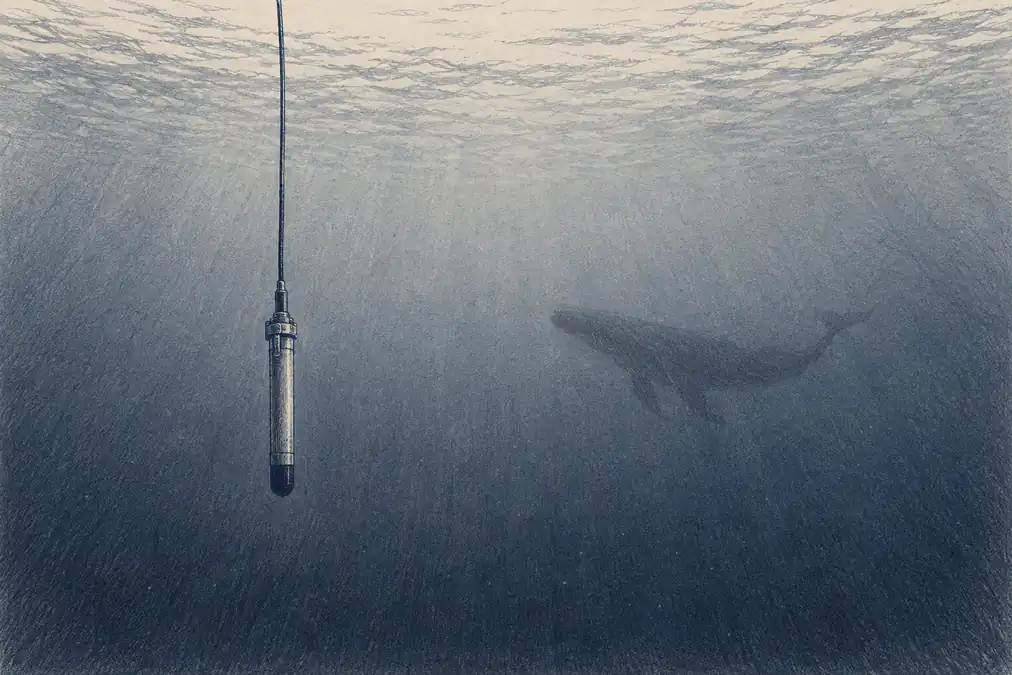
Sound goes where light cannot. During the Cold War the U.S. Navy laid lines of hydrophones along the ocean floor, the Sound Surveillance System, SOSUS, to listen for Soviet submarines across whole ocean basins. Its operators kept logging a low, unexplained sound they called the Jezebel monster. After the system was declassified in 1991, the Cornell bioacoustician Christopher Clark was given access, and in 1992 he recognised the frequency of a blue whale and realised that arrays hundreds of kilometres apart were hearing the same animal. A network built to find submarines turned out to be the finest whale observatory ever made.
The ocean's interior needed something more systematic. In 1999 the first floats of a program called Argo went into the sea. Each float drifts at a depth of 1,000 metres, sinks to 2,000 metres every ten days, then rises to the surface measuring temperature and salinity on the way up, radios its profile to a satellite and sinks again. By November 2007, 3,000 of them were spread across the open ocean, roughly one in every 3-degree square. Today about 4,000 are at sea, and in July 2024 the program collected its three-millionth profile. Before Argo, the ocean's interior was measured mainly along shipping lanes and research cruises. Now a robot surfaces somewhere every few minutes, reports, and goes back down without being asked.
CAMERAS, MICROPHONES, RADAR
Animals caught in the act
In the 1890s the American photographer George Shiras III rigged cameras to tripwires and magnesium flash powder, so that a deer brushing a wire at night took its own portrait in a blaze of light. National Geographic printed 74 of his photographs in July 1906, and several members of the society's board resigned in disgust at a serious journal filling up with pictures. The modern camera trap replaced the tripwire with a passive infrared sensor that fires when something warmer than the background moves in front of it, and strapped to trees from the Amazon to the Arctic, it now photographs animals that no researcher has ever seen alive in the wild.
Microphones did the same for sound on land. A small recorder left strapped to a tree or moored on a reef for weeks captures birds, frogs, bats and fish that never step in front of a camera, at night and in fog, through vegetation no lens can see past. For many species, especially the loud and the well hidden, the first reliable evidence that they still live somewhere is a recording.
Radar found birds without trying. British operators in the Second World War saw faint, drifting echoes on their screens that they called angels, which some claimed were souls heading home. The ornithologist David Lack, then working for the Army's Operational Research Group, showed that many were flocks of migrating birds, and after the war he turned the nuisance into a science. Today BirdCast, run by the Cornell Lab of Ornithology with Colorado State University and the University of Massachusetts, reads the U.S. weather radar network every night of the migration seasons, maps the birds in the air from sunset to sunrise, and forecasts how many will fly, so that cities can be asked to dim their lights on the heaviest nights. Radars built to measure rain now forecast birds.
TAGS
Animals that carry the instrument
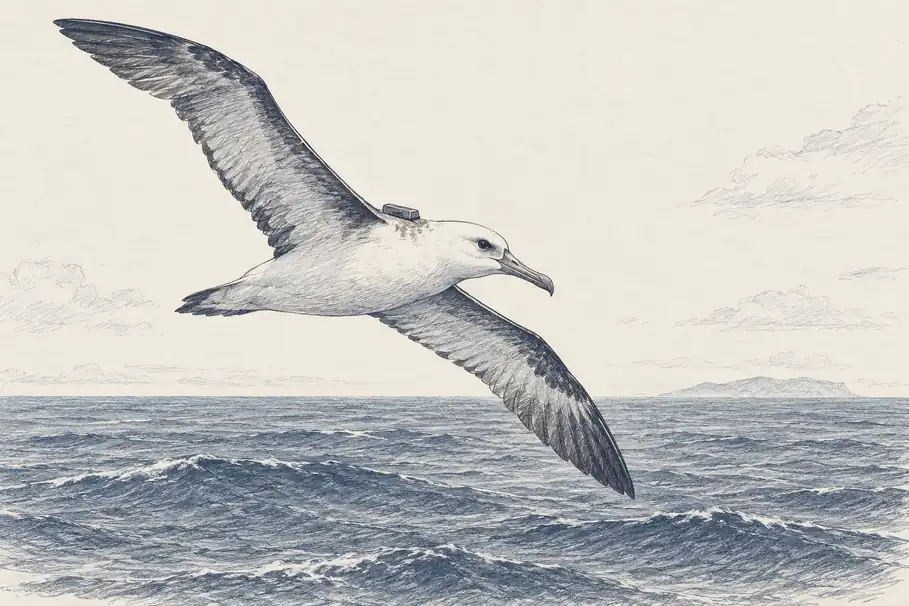
Mortensen's rings needed a stranger to find the bird. In 1978 the Argos system, built by NOAA and the French space agency CNES, removed the stranger: a transmitter on an animal sends a signal that satellites overhead can locate, so a seal, a turtle or an albatross reports its own position from anywhere on the ocean. Tags shrank from there, and GPS collars eventually let an animal record its own track. The ICARUS initiative, begun in 2002, aimed the idea at creatures too small for conventional tags and installed a receiving antenna on the International Space Station in 2018. The ring had become a radio.
What the tags revealed was frequently hard to believe. In 2007 a female bar-tailed godwit known as E7, carrying a small satellite transmitter, left Alaska on 29 August and landed in New Zealand just over eight days later, having flown 11,680 kilometres across the Pacific without stopping, eating or drinking. Ornithologists had suspected the route. Nobody could have proved it by watching, because nobody can follow a bird across an ocean for eight days, and the bird was not in a position to file a report.
Then the animals started collecting data about the ocean itself. Since 2004, southern elephant seals have carried small sensors glued to their heads that record temperature and salinity as they dive, often to 500 metres and sometimes to 2,000, and relay the profiles through Argos when they surface. The seals go where ships cannot, under the winter sea ice around Antarctica, and they have supplied most of the temperature and salinity profiles ever taken there. Some of the most productive oceanographers in the Southern Ocean are elephant seals, who have no idea they are employed.