COSMICS · CHAPTER 5.10
Can the Whole Planet Share One State?
Not one model of Earth, but many systems capable of referring to the same changing world.
EARTHVISION LAB · ~16 MIN READ
ONE CHANGING WORLD
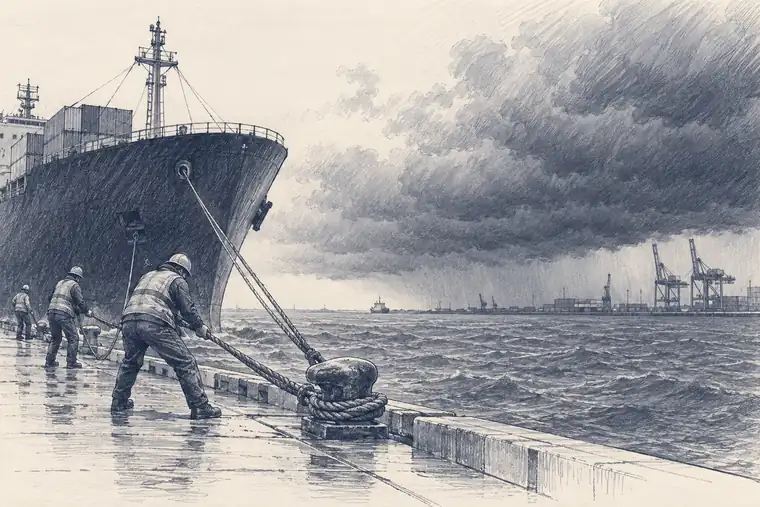
At one moment, a cyclone forecast changes the expected inflow to a reservoir. The reservoir changes downstream flood risk and hydropower output. Cloud changes solar generation. Wind changes both the storm track and the grid forecast. A port considers closing. Ships alter routes. Crop fields downstream have three weeks left before harvest. Every system has a model. None of the models owns the whole consequence.
This is the final architecture problem. The objective is not a single enormous model containing atmosphere, rivers, grids, crops, ships and institutions. The previous volume explained why that becomes impractical very quickly. The objective is weaker and more useful: let specialized systems maintain compatible beliefs about the same changing world.
Compatible does not mean identical. The cyclone can remain a probability field. The reservoir can remain a time series and operating model. The power grid can remain a network. The ship can remain a moving object with a route. The field can remain a parcel with a crop state. Intelligence begins when those different representations can refer to one another without pretending they are the same kind of thing.
IDENTITY, TIME, PROVENANCE
Shared state is made of claims, not one giant table
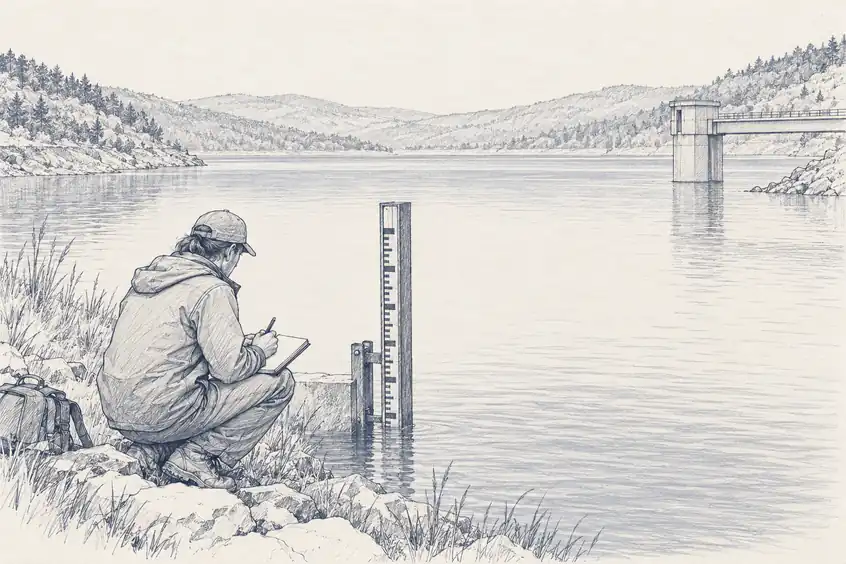
A useful shared state can be thought of as a set of claims about things and places. Reservoir X had this level at 06:50 UTC, measured by gauge Y. Forecast model Z expects this inflow distribution over the next twelve hours. Transmission line Q is available now but exposed to wind above a stated threshold. Each claim needs an object, a time, a source and a validity condition.
Identity is what lets two systems know they are talking about the same thing. A river model may use a reach identifier, an asset system a dam identifier, a cadastral system a parcel identifier and a shipping system a vessel identifier. The identifiers do not need one universal numbering scheme. They need resolvable relationships so the reservoir downstream of this catchment is the same reservoir the grid model calls plant R14.
Time needs similar discipline. A value without a timestamp is nearly useless in a changing system. A value with a timestamp but no validity interval can be equally misleading. A soil observation from yesterday may still be relevant. A convective-weather observation from yesterday is archaeology. Shared state has to know not only when something was observed, but how quickly that kind of information expires.
Provenance prevents estimates from masquerading as measurements. Two numbers can look identical while one came from a gauge five minutes ago and another came from a model initialized six hours earlier. The state should carry enough lineage to distinguish observed, derived, forecast and generated information. Otherwise a reasoning system receives certainty without knowing who supplied it.
PROTOCOLS BEFORE SUPER-MODELS
The real world already runs on federated data exchange
There are useful precedents for this less glamorous architecture. The OGC SensorThings API standard defines a common way to expose heterogeneous sensor systems through concepts such as Things, Locations, Sensors, Observed Properties, Datastreams, Observations and Features of Interest. It does not force every sensor to produce the same data. It gives different systems a shared grammar for asking what was observed, by what, where and when.
The standard also separates sensing from tasking. That distinction maps neatly onto the intelligence loop built in the previous chapters: one interface describes observations, another can describe requests made back to devices. Observation and action become parts of the same interoperable system rather than unrelated software stacks.
Weather data exchange provides an operational example at much larger scale. WMO's Information System 2.0 entered its operational phase on 1 January 2025. National and other WIS2 nodes publish notifications, while Global Brokers redistribute those notifications, Global Discovery Catalogues expose metadata and Global Caches provide access to core data. MQTT carries event notifications and HTTP carries the data itself.
WIS2 is not a planetary-intelligence system and does not claim to be one. That is precisely why it is useful here. It shows that global infrastructure can remain federated, operated by many organizations, and still provide timely discovery and exchange through common protocols. The first requirement for shared intelligence may be less exotic than a universal model: everyone has to stop inventing a private way to say new data arrived.
ORCHESTRATION
The reasoning layer has to know which system to ask
Once state can be addressed across systems, a reasoning layer does not need to contain every model internally. It can route questions. A flood question goes to hydrology. A generation question goes to a grid or renewable-output model. A crop question goes to an agricultural model. The reasoning problem is deciding which tools are relevant and how one result changes what should be asked next.
Cross-domain implications are where this becomes more than a catalogue of APIs. A cyclone forecast can imply reservoir inflow. The inflow can alter both flood risk and hydro generation. Grid stress can change the consequence of a port closure or heatwave. No individual model needs to predict the entire chain. The orchestration layer needs to notice that the output of one domain changes the state another domain should evaluate.
Contradictions matter just as much as implications. A satellite-derived flood extent may disagree with a hydrological forecast. A field sensor may indicate wet soil while the land model remains dry. A vessel may appear in radar after its broadcast track ends. The correct response is not always to average the two answers. It may be to preserve the disagreement and ask which evidence is stale, biased or measuring a different part of the state.
This is why the architecture needs uncertainty and provenance alongside values. Routing only confident point estimates through a chain makes the whole system look more certain at every interface. Routing distributions, assumptions and validity windows allows the next component to reason about the quality of what it received rather than treating every upstream output as ground truth.
PLANETARY INTELLIGENCE
The machine is a loop, not a model
The architecture that emerges is a loop. Observations update state. Specialized models push parts of that state into possible futures. A reasoning layer notices implications, conflicts and missing evidence. Uncertainty determines whether the system can act on what it knows or should request another observation. New evidence returns to the state and the loop begins again.
No component has to understand the whole planet. A weather model can remain a weather model. A hydrological model can remain a hydrological model. A satellite can remain an instrument. Intelligence appears in the coordination: knowing which model is relevant, how outputs relate, when an answer has expired, where evidence conflicts and what observation would reduce the uncertainty most.
The system also never reaches a final state. Earth keeps moving while computation runs. A forecast changes when a new observation arrives. A decision changes the system being forecast. A sensor task changes which evidence will exist next. The target is therefore not a perfect digital copy frozen at one instant. It is synchronization good enough to remain useful while the underlying world refuses to stop.
That is a less theatrical destination than a digital brain for Earth. It is also more demanding. A brain metaphor suggests one model with one internal view. A planetary intelligence is more likely to be a federation of instruments, databases, physical models, learned models and decision systems that continuously negotiate what the current state means and what should happen next.
The achievement would not be that Earth finally fits inside a computer. It would be that our systems can notice a consequential change, connect it to the parts of the planet that change makes relevant, admit when the evidence is insufficient, and turn that uncertainty into the next useful observation. Earth can continue declining to provide a final schema.
A planetary intelligence is not a model that contains Earth. It is a system that stays in useful conversation with a changing Earth.