COSMICS · NOTE 001.4
Can We Watch Plants Breathe?
A faint glow from leaves may change how we see the living planet.
EARTHVISION LAB · ~15 MIN READ
THE HIDDEN SIGNAL
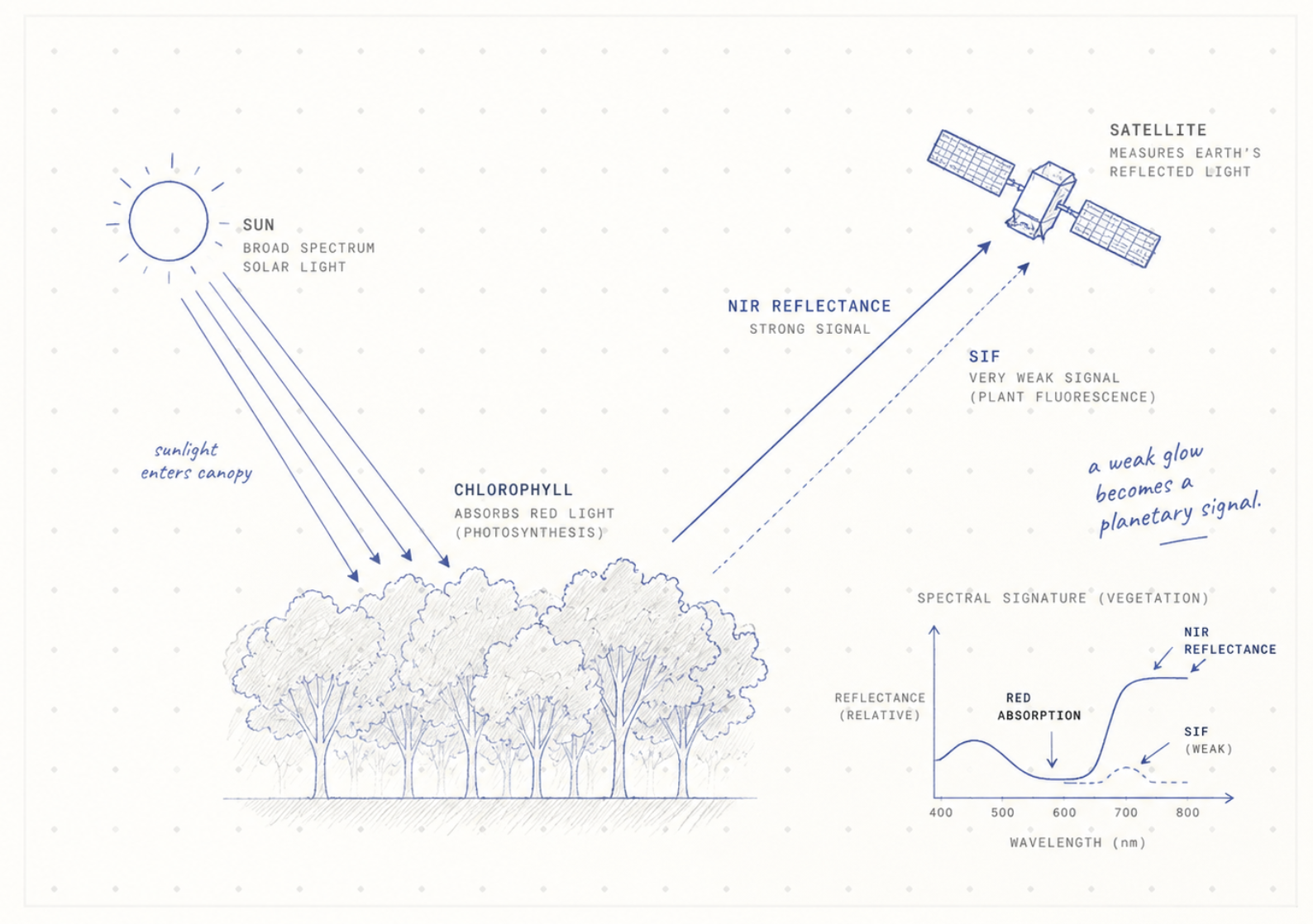
When a leaf absorbs sunlight, not all of that energy becomes growth. A tiny fraction is released again as a faint glow called fluorescence. Human eyes cannot see it. A carefully built spectrometer can.
This matters because the glow is linked to photosynthesis, the process by which plants turn light, water and carbon dioxide into stored chemical energy. For decades, satellites have been very good at showing where vegetation is green. A new generation of measurements wants to ask a different question: how actively is that vegetation working?
THE OLD VIEW
Green is not the same as productive
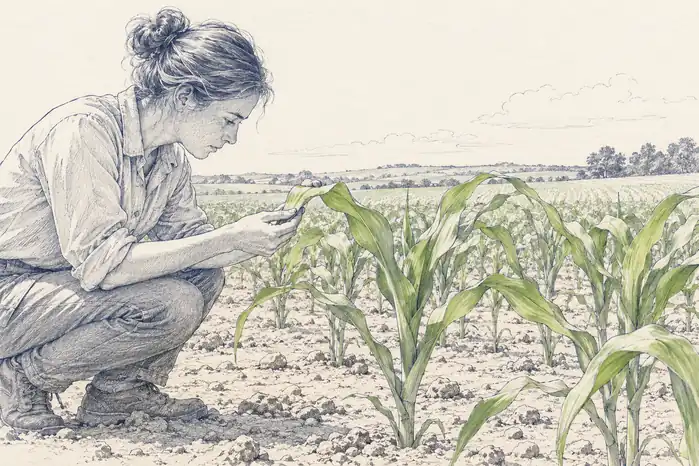
A crop can remain green while already under stress. A forest canopy can look healthy in a conventional image while photosynthesis has slowed. Colour tells us something important, but it does not tell us everything happening inside the leaf.
Vegetation indices such as NDVI became powerful because they made plant cover measurable at enormous scale. They helped turn satellite images into agricultural and ecological tools. But they are mostly indirect measures.
Solar-induced fluorescence offers another window. It is faint, difficult to isolate and much closer to the machinery of photosynthesis itself.
A NEW MISSION
FLEX is built around that faint signal
ESA's FLEX mission is scheduled to launch with Copernicus Sentinel-3C on 15 September 2026. FLEX carries a Fluorescence Imaging Spectrometer designed to measure the weak fluorescence emitted by plants as they absorb sunlight.
The mission will work with Sentinel-3 observations of land and atmosphere. One satellite helps describe the scene. The other looks for the subtle signal coming from plant function.
The pairing is interesting because it moves Earth observation one small step from appearance toward process.
FROM ORBIT TO FIELD
What could a farmer learn?
The obvious hope is earlier stress detection. If photosynthetic activity changes before leaves visibly yellow or wilt, fluorescence could reveal trouble sooner than ordinary colour imagery.
But turning a global satellite measurement into a field decision will not be automatic. Clouds, canopy structure, crop type, viewing geometry and spatial scale all matter. FLEX is expected to produce global fluorescence maps at about 300 metre resolution, useful for science but much coarser than a single small farm.
The mission should therefore be judged carefully. Not by whether the images look new, but by whether the measurement changes what people can know and do.
THE BIGGER QUESTION
Plants are part of the carbon machine
Photosynthesis is one of the largest flows of carbon on Earth. Plants pull carbon dioxide from the atmosphere and move carbon into leaves, wood, roots and soils. Small changes across enormous areas matter to the global carbon cycle.
That makes fluorescence interesting far beyond agriculture. It may help scientists test how vegetation responds to drought, heat and changing climate conditions. It can also help improve models of how much carbon ecosystems are taking up.
For the first time, we may begin to watch a global biological process through a signal generated by the process itself.
DO NOT CONFUSE MEASUREMENT WITH MEANING
A new signal can still be misunderstood
There will be a temptation to treat fluorescence as a direct meter of plant health. It is not that simple. Photosynthesis changes with light, water, temperature, species and the way plants regulate energy. The same fluorescence value can mean different things under different conditions.
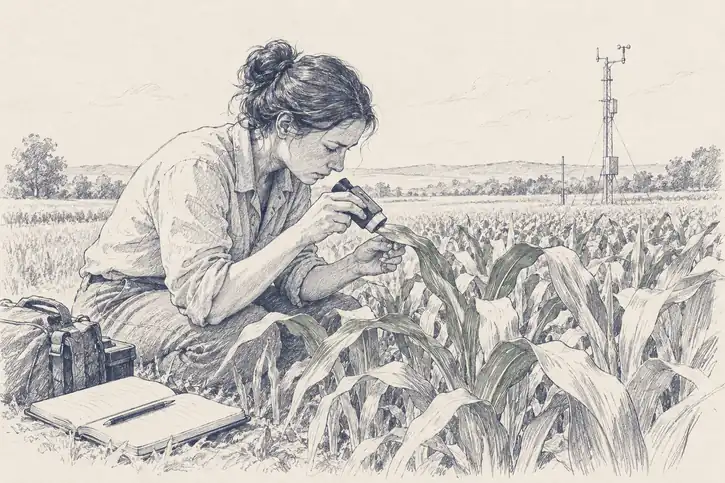
The hard work will be calibration and interpretation. Scientists will compare the satellite signal with towers, field instruments, crop measurements and ecosystem models.
This is how new planetary measurements usually become useful. First we learn to see a signal. Then we spend years learning what the signal really means.
THE POSSIBILITY
A living planet needs living measurements
Much of Earth observation has been about shape, colour, temperature and motion. Those are powerful properties, but life is also process.
A leaf opens pores. Water moves. Carbon enters. Sugars form. Energy is stored. Stress changes the whole sequence. If satellites can begin observing those processes rather than only their visible consequences, the idea of planetary intelligence changes.
We stop asking only what Earth looks like from space. We begin asking what Earth is doing.