COSMICS · CHAPTER 3.6
A Bird, a Jaguar and a Whale Became Data
Tags, camera traps and acoustics turned individual animals into records that update over a lifetime.
EARTHVISION LAB · ~14 MIN READ
A NEW KIND OF RECORD
Everything in the last two chapters was about places: a cell, a coordinate, a patch of ground that stays put and gets re-measured. Animals broke that model completely. An animal is a record whose position is the interesting part, whose identity has to persist across sightings, and whose data only makes sense as a sequence.
Representing that required three separate inventions: a way to follow one animal through space, a way to recognize the same individual twice without following it, and a way to detect presence without seeing anything at all.
TAGS AND TRACKS
Following one animal through its whole life
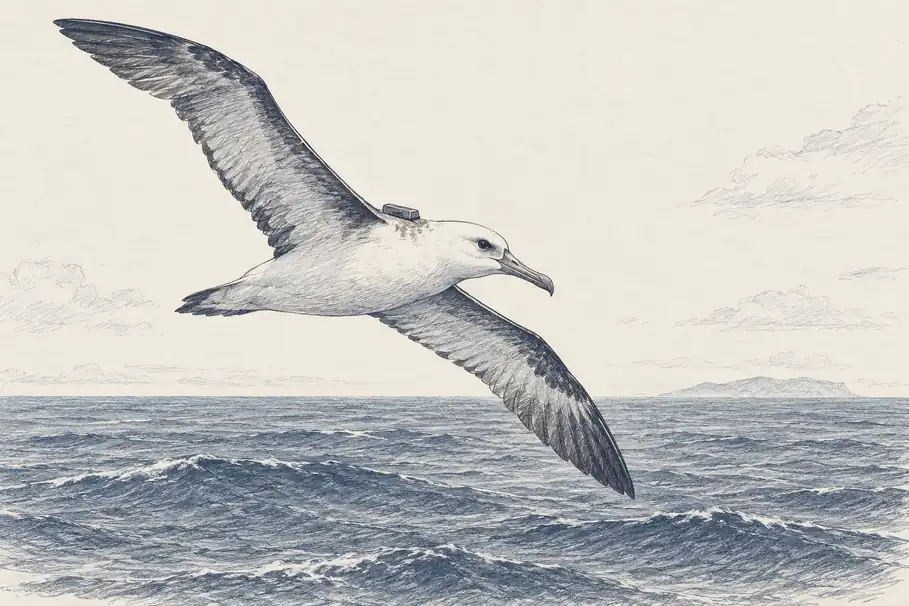
The Argos system, established in 1978 by NOAA and the French space agency, gave wildlife biology its first satellite-based tracking capability, allowing a transmitter on an animal to be located from orbit rather than by someone with a receiver walking through the field. Tags shrank steadily from there, and GPS tags eventually let a collar record its own position rather than being located by someone else.
The ICARUS initiative, begun in 2002, aimed the same capability at animals too small to carry conventional tags, with a receiving antenna installed on the International Space Station in 2018. Movebank, the database where much of this converges, now holds on the order of 6 billion location records from more than 1,400 species.
What that produces is not a map of where a species lives. It is a set of individual biographies: this particular bird, this particular route, this particular year it left three weeks late. Population-level range maps are averages built on top of that. The tracks themselves are the raw form, and they carry variation between individuals that any range map necessarily flattens.
IDENTITY WITHOUT INSTRUMENTS
Recognizing the same animal without a tag
Tagging is invasive, expensive, and limited to animals a team can physically catch. The alternative is to use markings the animal already carries. Volume 1 already described how this works for one species: the spot pattern behind a whale shark's gills is effectively a fingerprint, and the nonprofit Wild Me's Sharkbook platform matches new photographs against a global catalogue of those patterns, returning a ranked list of candidates for a person to confirm.
The same trick generalizes far beyond whale sharks, because a surprising number of species carry natural markings unique enough to serve as an identifier: zebra stripes, giraffe coat patches, the trailing edge of a whale's fluke, the rosette pattern on a jaguar. In each case the representational move is identical. An individual becomes computable the moment a natural pattern and a matching function replace a tag that would otherwise have to be physically attached.
That is worth stating as a general principle, because it is the cleanest example in this chapter of what representation actually requires. Identity is not a property of the photograph. It is a persistent identifier plus a function that can compare a new observation against every old one and return a confidence, and once both exist, a lifetime of sightings scattered across oceans and decades collapses into one biography.
CAMERAS AND MICROPHONES
Detecting animals nobody sees
A motion-triggered camera does not know what it photographed. It knows something moved. An acoustic recorder does not know what called. It knows air pressure changed in a pattern. Both convert animal presence into a record without anyone being there, and both produce far more material than any team can review, which is the backlog problem this volume already described in its third chapter.
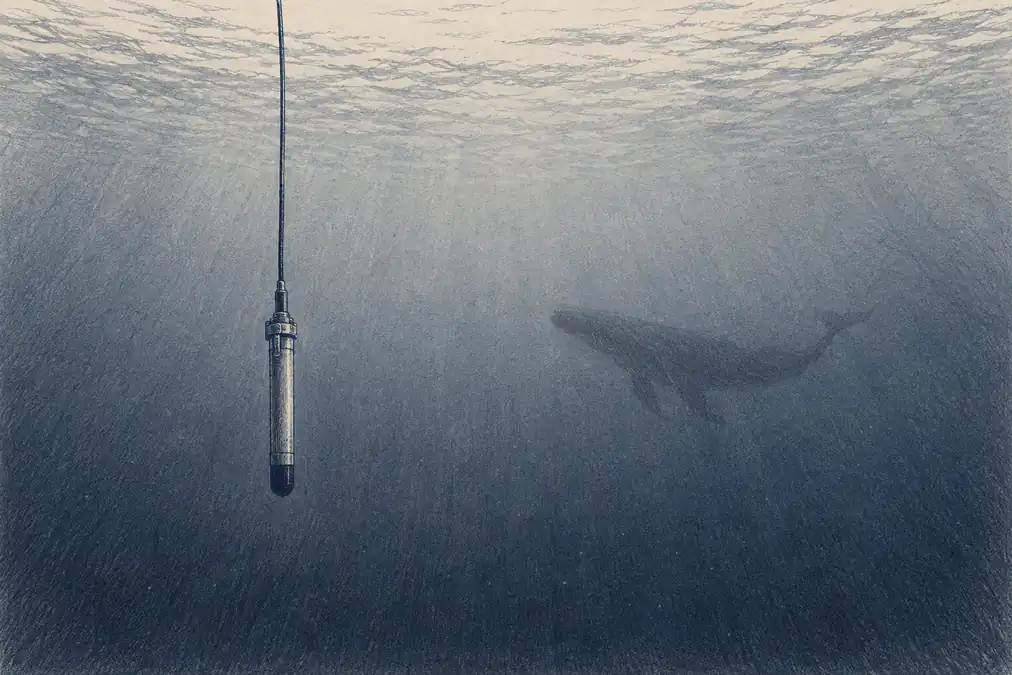
Acoustics extend the reach furthest, because sound passes through vegetation and darkness that defeat a camera. A recorder in a canopy captures species that are never photographed, and a hydrophone captures marine animals nobody could observe at all. What it produces is a waveform, which is to say a measurement of pressure over time, with the identity of the animal still locked inside it.
That locked-in quality is the honest state of this data through the whole period this volume covers. The recordings existed. The tracks existed. The photographs existed. Turning them into species, individuals and behaviors at scale is a story that belongs to Volume 5, and it did not become possible until long after the collecting started.