COSMICS · CHAPTER 3.1
Before the World Had Variables
For most of human history, reading the planet meant reading signs, and the reader was the instrument.
EARTHVISION LAB · ~12 MIN READ
THE UNWRITTEN INSTRUMENT
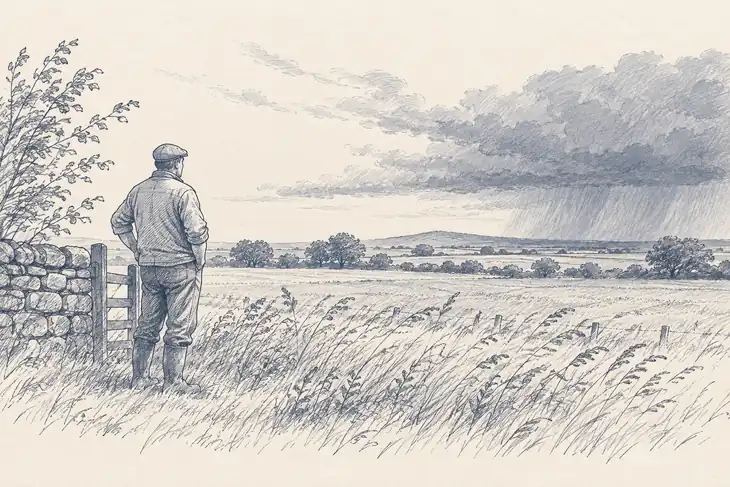
A farmer who knows that a particular wind carries rain within two days holds a working forecast. It has a lead time, a skill score somewhere above chance, and a failure mode. What it does not have is a number, a unit, or any way to be checked by someone standing elsewhere.
That was the entire condition of environmental knowledge for most of human history, and it was not primitive. It was highly refined, locally accurate, and completely non-transferable. The instrument was the person, calibrated by a lifetime in one valley, and when they died the calibration went with them.
EARLY SYSTEMS
Several civilizations reached the same conclusion separately
Aristotle's Meteorologica, written around 340 BCE, tried to give weather a causal structure rather than a divine one: exhalations from the earth, moist and dry, producing rain, wind and lightning. The mechanism was wrong in nearly every particular. The move was right, and it is the same move this entire book keeps returning to. He treated the sky as something with rules that could in principle be stated.
The same instinct appears independently elsewhere. Indian agricultural traditions encoded planting decisions against monsoon onset in verse form, because verse survives transmission better than prose. Chinese records tied agricultural activity to a division of the solar year into 24 named periods, each one a short instruction about what the land was doing. Polynesian navigators read swell patterns refracting around islands they could not yet see, holding in memory a model of ocean behavior that would not be written down in physics for another two thousand years.
None of these produced a variable. They produced rules of thumb attached to named situations, which is a different data structure entirely: dense, contextual, and impossible to average across two observers.
READING OTHER SPECIES
The best early sensors were alive
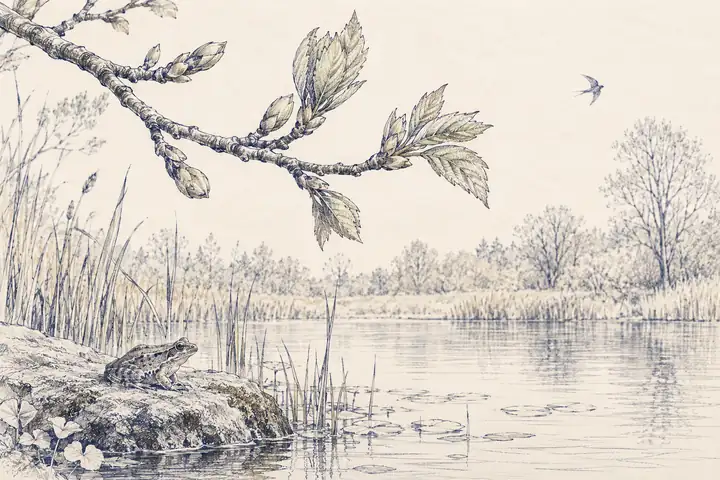
Long before anyone measured soil moisture, people read plants that had already measured it. A tree flushing leaves early, a particular flower opening, frogs calling from a pond edge, birds arriving or leaving: each is a living integrator, summing temperature, water and light over weeks into a single visible event. Phenology, the study of the timing of those events, is the oldest environmental dataset humanity has, and it was collected for centuries before anyone thought of it as data.
This matters for a specific reason that reappears in Volume 5. A plant's bud burst is not a measurement of any one variable. It is an organism's own integration of many, weighted by what actually matters for survival. Modern instrumentation can measure each input far more precisely and still struggle to reproduce the judgment the organism was making.
Some of these records survived into the modern era and became real scientific series. Japanese court documents recording cherry blossom flowering dates in Kyoto, kept intermittently for over a thousand years, are now used as a temperature proxy, because the flowering date responds to late-winter warmth. The people writing them down were not building a climate record. They were noting when the trees looked their best.
THE FIRST TRADE
What the shift to variables cost
Everything that follows in this volume is a story of converting this kind of knowing into numbers, and the conversion is usually told as pure gain. It was not. Sign-reading carried context the number cannot: not just that the wind was from the southwest, but that a southwest wind in this valley in this season after this kind of dry spell tends to behave a certain way. Compressing that into wind direction in degrees keeps the direction and discards the conditional structure around it.
The trade was still worth making, for one reason that has nothing to do with accuracy. A number can travel. It can be compared to a number taken by a stranger a thousand kilometers away, checked, averaged, and stacked into a record longer than any human memory. That is what the next chapter is about, and it required something harder than building an instrument. It required agreement.