COSMICS · CHAPTER 3.2
When Nature Became Numbers
A thermometer is an agreement before it is an instrument. Somebody had to decide what zero meant.
EARTHVISION LAB · ~13 MIN READ
AN AGREEMENT FIRST
Building a tube of liquid that rises when warmed is straightforward. Deciding that the height of the liquid means 21 degrees, and that your 21 degrees and mine are the same 21 degrees, is the hard part, and it took roughly two centuries to settle.
This is the step that turns an instrument into a measurement. Without a shared scale, a thermometer produces a private impression with a number attached. With one, it produces something two strangers can argue about productively.
THE FIRST SENSORS
Four instruments that made the atmosphere countable
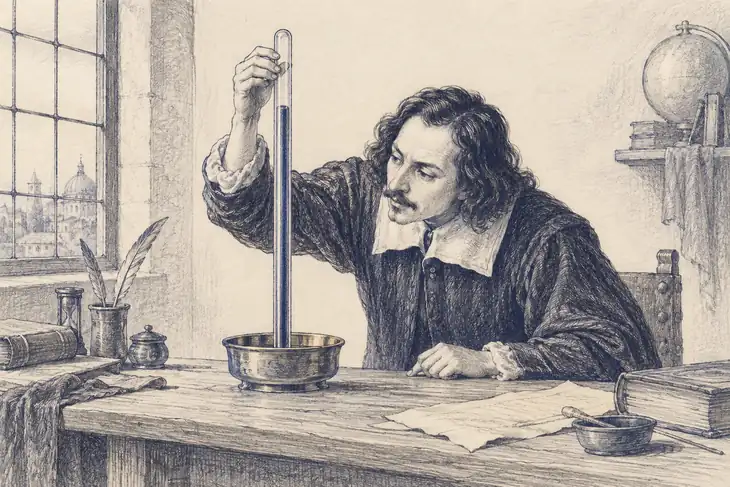
Evangelista Torricelli built the first mercury barometer in 1643, and in doing so demonstrated something stranger than a weather instrument: that air has weight, and that the weight changes. The column height was not really measuring pressure as an abstraction. It was weighing the atmosphere directly, using mercury as a counterbalance.
Daniel Gabriel Fahrenheit produced a mercury thermometer with a reproducible scale in 1714, meaning two instruments built to the same specification would agree. Anders Celsius proposed his own scale in 1742, defined against the freezing and boiling points of water, which had the practical advantage of being anchored to something anyone could reproduce in a kitchen. Rain gauges are older than both, with standardized versions in use in Korea from the 1440s under the Joseon dynasty, distributed to administrative districts specifically so that rainfall in one province could be compared against another.
That Korean detail is the important one. The gauge itself is a bucket. What made it a measuring system was a bureaucracy deciding that every district would use the same bucket and report the results to the same place.
STANDARDIZATION
One reading is a curiosity, a network is a dataset
A single station tells you the weather where the station is. The value multiplies non-linearly with coverage, because the moment you have two stations you have a gradient, and a gradient is the beginning of physics. Pressure differences drive wind. Temperature differences drive circulation. None of that is visible from one point no matter how precisely you measure it.
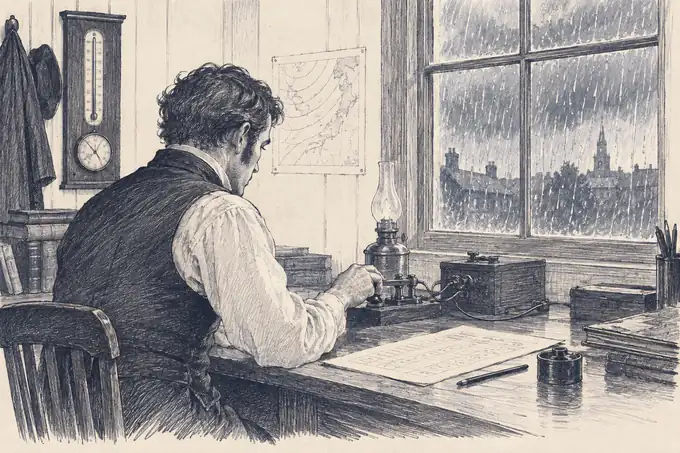
The telegraph is what made this operational. Before it, a network of stations could produce a historical record but never a current picture, because the readings travelled slower than the weather did. After it, observations from across a continent could be assembled in one room faster than the storm they described could cross it. Weather forecasting as a public service begins there, not with better instruments.
The same requirement runs through everything later in this book: river gauges reporting to a basin authority, ocean depth soundings compiled into charts, Argo floats drifting through the ocean and surfacing to transmit. In each case the instrument was the smaller problem. The agreement about units, timing, calibration and reporting was the system.
WHAT GOT DISCARDED
The scale decides what counts as the same
A standardized measurement makes two places comparable by asserting that one property of them is the same kind of thing. That assertion is productive and slightly false. Air temperature at two meters above short grass, the standard for a weather station, is a real number that ignores the fact that the ground beneath it may be bare rock in one place and wet peat in another, with completely different consequences for anything living there.
The standard is not wrong. It is a deliberate narrowing, chosen so that comparison becomes possible, and the narrowing is invisible in the resulting number. Two centuries later, models trained on those records inherit the same narrowing, without any note attached explaining what the standard chose to ignore.