COSMICS · CHAPTER 3.8
Humans and Machines Began Leaving Tracks
Aircraft, ships, phones, tractors and grids broadcast their own positions, and Earth acquired a second, artificial nervous system.
EARTHVISION LAB · ~13 MIN READ
A DIFFERENT KIND OF SENSOR
Everything measured so far had to be observed by something else. A forest does not report its own greenness. But an aircraft broadcasts its identity, position, altitude and velocity several times a second, to nobody in particular, because air traffic safety requires it. So does a ship. So, in a different way, does a phone.
This produced a category of planetary data with no precedent: measurements the subject generates about itself, continuously, as a byproduct of operating. It is the densest and most complete layer in the whole system, and almost none of it was created for environmental purposes.
ADS-B AND AIS
Aviation and shipping made themselves legible for safety
ADS-B, Automatic Dependent Surveillance Broadcast, has aircraft determine their own position by satellite navigation and broadcast it openly, replacing a model where the ground had to find them with radar. AIS, the Automatic Identification System, does the equivalent for vessels, transmitting identity, position, course and speed so that ships can see each other and coastal authorities can see traffic.
Both were mandated for collision avoidance. Both turned out to be planetary datasets. AIS underpins the entire field of fisheries monitoring, because a vessel's movement pattern reveals whether it is transiting or actively fishing, and because a vessel that switches its transponder off in a protected area has communicated something by its silence. Aircraft data has been used to study contrail formation and to reconstruct how aviation activity collapsed and recovered during the pandemic.
The environmental uses were entirely accidental. This is the collect-now-understand-later pattern again, except the collectors were regulators writing safety rules, and the later understanding came from researchers with no connection to them.

THE GROUND LAYER
Farm machinery, grids and phones
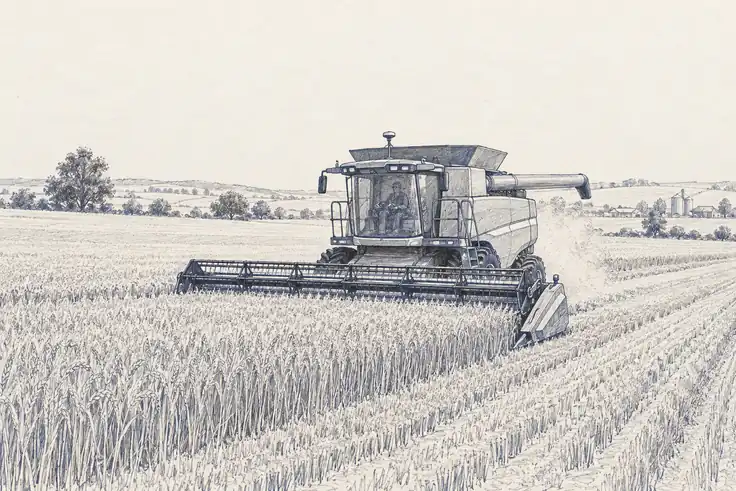
A modern combine harvester records yield continuously as it moves, producing a map of a field at a resolution no satellite approaches, tied to exact position by the same navigation systems described two chapters ago. Tractors log where they applied what. The result is that individual farms now generate ground truth of a quality that agricultural remote sensing spent decades trying to approximate, and it sits in private hands under commercial terms.
Electricity grids instrument themselves for operational reasons and produce demand curves that are, incidentally, one of the sharpest available indicators of human activity, weather stress and economic disruption. Air quality moved the same direction: Aclima's sensor platforms, mounted on Google Street View cars, report pollutant concentrations at roughly one-second intervals while driving, revealing that concentrations can shift sharply within a few hundred meters, variation a single fixed city monitor was never built to see.
Phones are the most complete and most fraught layer of all. Aggregated mobility data has been used to study everything from disaster evacuation to disease spread, and it is the only dataset in this book where the measured subject is a person who did not choose to be measured for this purpose.
WHO GETS REPRESENTED
The best-instrumented parts of Earth are the ones with money
This layer has a bias that the satellite layers do not. A satellite passes over everywhere. ADS-B, AIS, connected machinery and dense sensor networks exist where there are aircraft, ships, capitalized farms and municipal budgets, which means the artificial nervous system is thick across wealthy, industrialized geography and thin exactly where environmental risk is often highest.
That asymmetry propagates. A model trained mostly where instrumentation is dense learns the relationships that hold there, and applying it elsewhere is an extrapolation dressed as a measurement. The gap does not appear anywhere in the output, which is precisely what makes it dangerous.