COSMICS · CHAPTER 3.3
Collect Now, Understand Later
Humanity started gathering far more about Earth than it could interpret, and kept doing it for two centuries.
EARTHVISION LAB · ~13 MIN READ
THE ACCUMULATION
Somewhere in the nineteenth century, collecting information about the natural world stopped being tied to answering a specific question and became a standing practice, done because the material might matter later. Specimen drawers, field notebooks, ships' logs, station records: none of it was gathered to answer the questions it is now used to answer.
This is one of the stranger inheritances in science. Enormous portions of what we now know about planetary change rest on records assembled by people who had no idea the record would become the point.
ACCIDENTAL RECORDS
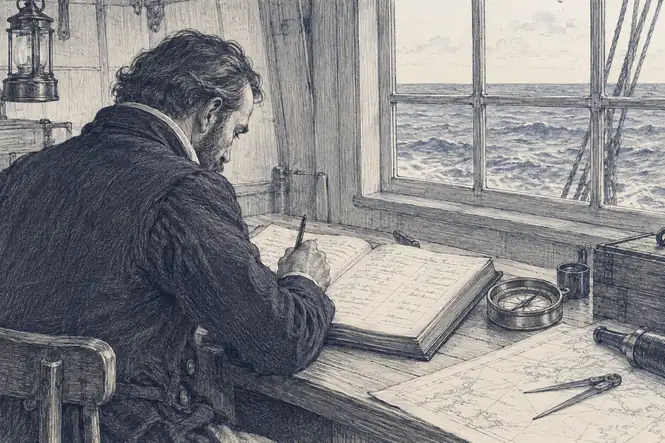
Ships kept logs for navigation and left a climate archive
Naval and merchant vessels recorded wind, weather, and position because a ship that does not know these things ends up on rocks. Those logs, kept for operational safety across two centuries, are now one of the primary sources for reconstructing ocean and atmospheric conditions before instrumental networks existed. Projects transcribing them have converted handwriting from vessels that sank long ago into rows in a modern climate database.
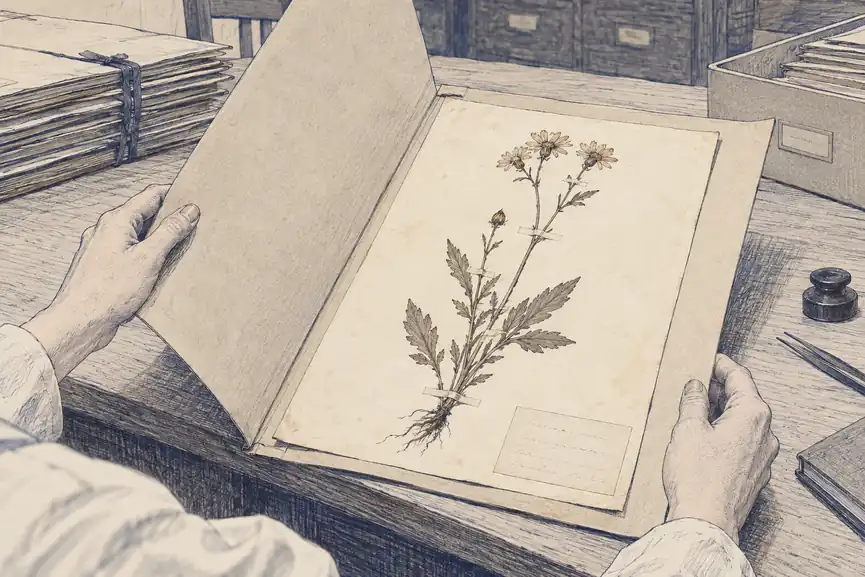
The same pattern runs through natural history collections. Herbarium sheets and preserved specimens were gathered to describe and classify species. Each one also happens to carry a date and a location, which means the collection as a whole is an unintentional record of where species were and when, now used to measure range shifts nobody was watching for at the time.
In both cases the value came from a property the collectors were not optimizing for: consistency across a long period. Nobody was trying to build a time series. They were doing their jobs the same way for a long time, which is the same thing.
TODAY'S BACKLOG
The modern version has the same shape and far more volume
Camera traps fire when something moves and fill storage cards with millions of frames, most of them empty. Acoustic recorders left in a canopy produce weeks of audio nobody can listen to at listening speed. Ocean buoys, aircraft sensors, soil probes and satellites all generate more than any team can inspect. The bottleneck stopped being collection some time ago and has been interpretation ever since.
The mining industry offers an unusually clean example of what happens when that backlog is finally read. KoBold Metals, an exploration company backed by investors including Bill Gates and Jeff Bezos, built its process around machine learning applied to a century of accumulated geological material: historical drill records, geochemical surveys, field reports and satellite imagery, most of it decades old and none of it collected with this use in mind.
In Zambia the approach pointed at the Mingomba deposit, now a $2.3 billion development that the company says moved from discovery to development in about five years, with an expected capacity of at least 300,000 tonnes of copper a year. The measurements that led there had existed for a long time. What did not exist was any way to hold all of them in view at once.
THE REAL CONSTRAINT
Collecting is cheap, curating is not
The reason the backlog persists is not laziness. Interpretation requires knowing what an old measurement actually meant: which instrument, which calibration, which convention for recording a missing value, which local practice for rounding. A drawer of specimens with inconsistent labels and a hard drive of camera trap images with no location metadata are the same problem in different centuries.
This is why the chapters that follow are about structure rather than volume. Turning an accumulation into something queryable required inventing shared ways to say where a thing was, when it was there, and what kind of thing it was. Without those, a bigger pile is just a bigger pile.