COSMICS · CHAPTER 4.4
Can We Compute a Forest?
Growth is slow, disturbance is fast, and the future depends on both.
EARTHVISION LAB · ~14 MIN READ
MODELLING LIFE
A tree may take a century to grow and minutes to fall. Soil carbon can turn over for centuries while a fire resets a stand in an afternoon. A forest model has to let slow accumulation and fast disturbance occupy the same future.
That makes forests different from systems where the governing material merely moves. Trees compete, allocate carbon, reproduce, close stomata during drought, die, and alter the conditions experienced by the organisms around them. The thing being predicted is also changing the rules of its local environment.
GROWTH AND SUCCESSION
From individual trees to cohorts
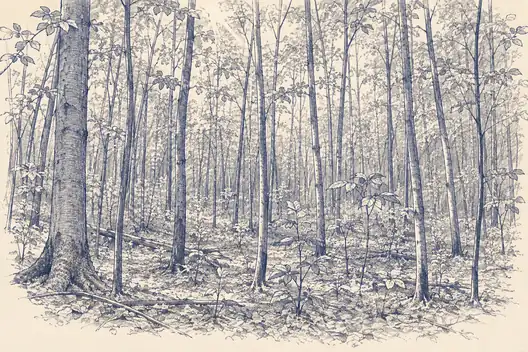
Detailed vegetation models represent trees individually or as cohorts grouped by size, age or functional type. They simulate competition for light, water and nutrients, then update growth, recruitment and mortality through time. Forest succession emerges from those interactions rather than being prescribed as a fixed sequence.
This is valuable because two stands with similar canopy cover can have very different futures. One may be dominated by young fast-growing trees, another by mature drought-sensitive trees. A forecast needs the demographic state underneath the canopy, not only the canopy itself.
Mortality is the difficult term. Growth follows comparatively well-studied physiological constraints. Death arrives through drought, insects, pathogens, wind, fire and combinations of them. The forecast error is therefore concentrated in the events that most strongly change the future.
DISTURBANCE
Disturbance is part of the model, not an interruption
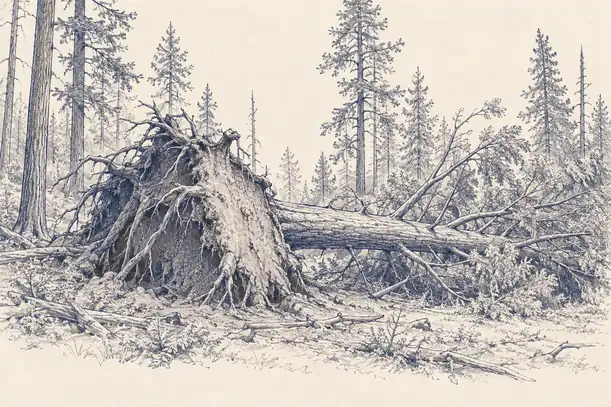
Fire, windthrow and insect outbreaks are often treated as modules attached to vegetation models because their dynamics run on different scales. That modularity is practical and dangerous. Fuel load depends on vegetation history, fire changes regeneration, drought weakens trees before insects arrive, and insect mortality changes future fuel. The modules are separate in software and coupled in the forest.
Forecasting carbon inherits the same problem. The long-term balance may be dominated by growth in ordinary years and by disturbance in a single extraordinary year. A model can estimate average productivity well and still miss the event that determines the decade.
This is why scenario ensembles matter here. The useful output is often not one forest in 2100, but a range of possible forests under different climate trajectories, disturbance regimes and management choices. Trees have enough uncertainty without being given one official future.
SCALING UP
The model changes when the map gets bigger
A model detailed enough to track individual trees cannot be run globally at useful speed. Global Earth-system models therefore compress vegetation into plant functional types or other aggregated representations. That makes coupling to atmosphere and climate possible while discarding much of the demographic detail that controls local mortality.
The modelling problem is not to find one perfect scale. It is to move information between scales without pretending nothing changed. Plot models know individual trees. Global models know fluxes. Regional prediction lives in the uncomfortable space between them, where both kinds of knowledge are necessary and neither fits neatly.