COSMICS · CHAPTER 4.1
The Equation That Tried to Predict Weather
Bjerknes stated the problem, Richardson tried it by hand and failed spectacularly, and ENIAC finally made it work in 1950.
EARTHVISION LAB · ~15 MIN READ
1904
In January 1904, Vilhelm Bjerknes published seven pages in Meteorologische Zeitschrift arguing that weather prediction was not a matter of pattern recognition or accumulated wisdom but an initial value problem in mathematical physics: given the state of the atmosphere now, and the physical laws it obeys, the future state is determined and can be computed.
He identified seven variables needed to specify that state, and the equations connecting them, drawn from fluid dynamics and thermodynamics rather than meteorological tradition. The claim was enormous and almost entirely theoretical. Bjerknes had no way to measure the current atmosphere in three dimensions and no way to perform the arithmetic, and he knew it.
1922
The man who tried to do it by hand
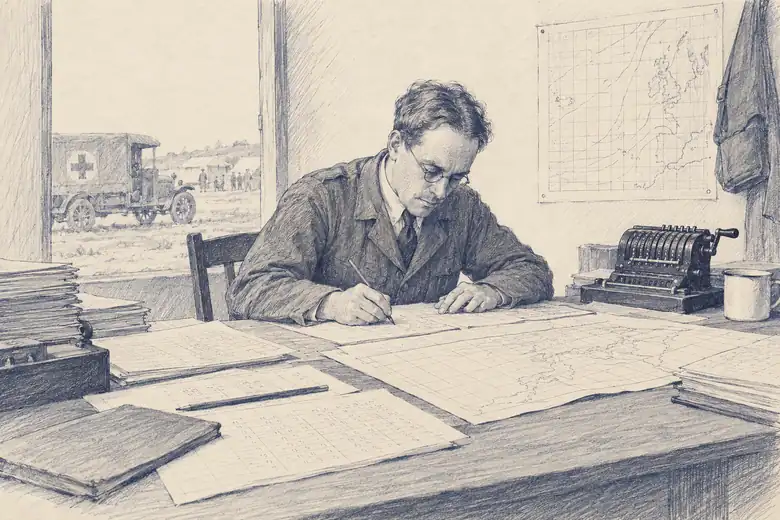
Lewis Fry Richardson took the proposal literally. Working partly while serving as an ambulance driver in the First World War, he devised a systematic numerical scheme, dividing the atmosphere into cells and stepping the equations forward in time, and published it in 1922 as Weather Prediction by Numerical Process. He then did what nobody else would have attempted: he carried out a trial forecast by hand.
It failed badly. His six-hour forecast produced a surface pressure change wildly larger than anything the real atmosphere does, and a contemporary reviewer noted that a wild guess would have landed closer. The arithmetic was not the problem. The scheme had admitted fast-moving acoustic and gravity waves that exist in the equations but contribute almost nothing to actual weather, and with large time steps those waves amplified into nonsense.
The time cost was equally damning. By his own reckoning it took roughly three months of hand calculation to produce a 24-hour forecast, meaning the method was not slow, it was retrospective. Richardson imagined solving this with scale: a vast hall of 64,000 human computers working in parallel, coordinated by a conductor, each responsible for one part of the globe. It reads as fantasy and is a startlingly accurate description of a parallel processor.
1950
The first forecast that beat the weather
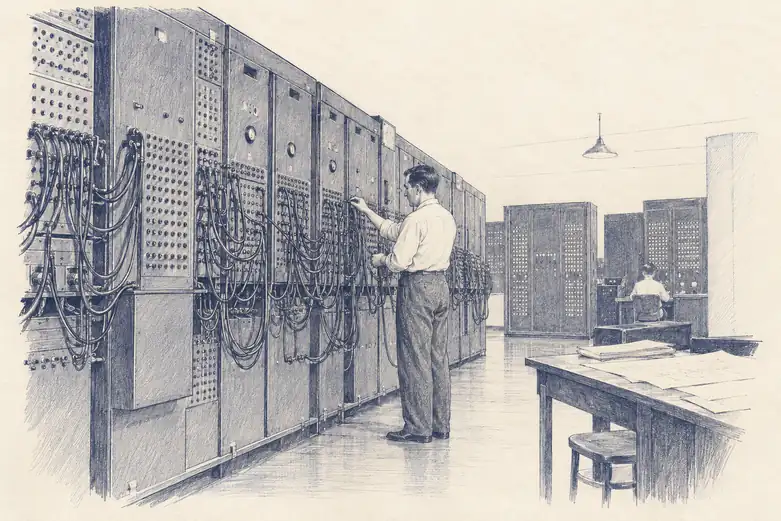
In 1950, Jule Charney, Ragnar Fjortoft and John von Neumann ran a numerical forecast on ENIAC at the Aberdeen Proving Ground and published the result as Numerical Integration of the Barotropic Vorticity Equation. Their success came from doing less than Richardson, not more. Rather than the full primitive equations, they used a simplified barotropic model that deliberately filters out the fast gravity waves which had destroyed Richardson's attempt, retaining only the slower Rossby waves that actually organize weather systems.
They forecast one variable, the geopotential height of the 500 hectopascal pressure surface, over North America, 24 hours ahead. The machine took about 24 hours of processing to produce a 24-hour forecast, which is exactly break-even and therefore useless operationally and epochal scientifically. Charney noted that with routinized operations it might be brought down to 12 hours.
That ratio, computation time against forecast lead time, is the metric the entire field has been improving ever since, and it is the same metric that reappears when machine learning models enter this story in Volume 5 producing ten-day forecasts in under a minute.
WHAT ACTUALLY CHANGED
The lesson was about what to leave out
The usual telling makes this a story about computers arriving. That is half of it. The deeper shift was the discovery that a more complete set of equations can produce a worse forecast than a deliberately incomplete one, because completeness admits phenomena that are physically real, numerically unstable, and irrelevant to the question being asked.
Every model in the rest of this volume inherits that lesson. A forest model that simulates every leaf, a hydrological model that resolves every pore, a food system model that tracks every household, would each be more faithful and less useful. Choosing what to exclude is not a compromise in this field. It is the method.