COSMICS · CHAPTER 4.5
Where Will the Animals Go?
Habitat can be forecast. Whether an animal reaches it is another model entirely.
EARTHVISION LAB · ~14 MIN READ
DISTRIBUTION MODELS
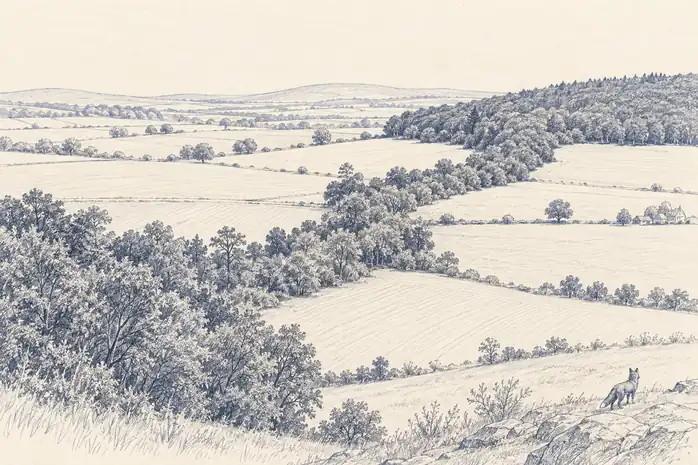
A common way to forecast a species range is to learn the environmental conditions associated with its known locations, then project those conditions into the future. Temperature rises, rainfall shifts, vegetation moves, and the map produces a new area labelled suitable. The species is not consulted.
This family of species distribution models is useful because climate variables can be projected everywhere. It is limited because occurrence is not determined by climate alone. Competition, predation, disease, habitat structure, history and human barriers can all decide whether suitable climate becomes actual habitat.
THE NICHE PROBLEM
Suitable is not occupied
Ecologists distinguish a fundamental niche, the conditions an organism could tolerate, from a realized niche, the subset it actually occupies after competition, predation and history have done their work. Most occurrence datasets reveal the second. A model can therefore mistake a historical absence for a physiological limit.
The error becomes more important under climate change. Project the realized niche forward and the model may identify a narrow future range even though the organism could tolerate more. Or it may identify a broad future range that remains biologically suitable but inaccessible. Both maps can be mathematically clean and ecologically wrong for opposite reasons.
This is why projections are often more reliable for comparison than for prophecy. A model may be weak at saying exactly where a species will live in 2080 and still useful for comparing which of two reserve networks retains more suitable climate.
MOVEMENT
A future habitat needs a route
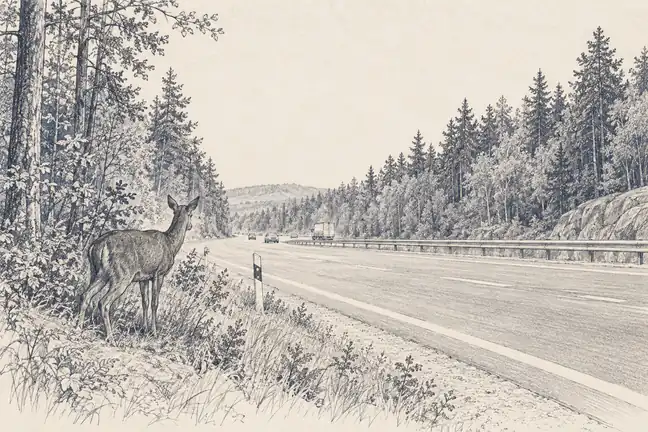
Movement models add the missing route. They estimate how animals respond to terrain, roads, settlements, water, vegetation and other features while moving, then simulate whether individuals can actually reach future habitat. The answer is often constrained less by climate than by a motorway, a fence or a gap between protected areas.
The time dimension matters as much as the route. Climate velocity describes how quickly a set of climatic conditions moves across the landscape. If suitable conditions move poleward or uphill faster than a population can disperse, the future habitat technically exists and practically does not.
Marine species make the geometry stranger. A useful feeding ground may be a temperature front or productivity feature that moves every week. Predicting the animal then requires predicting the feature first. Habitat is no longer a place. It is a moving condition.
CONSERVATION DECISIONS
The forecast changes the landscape before the animal arrives
Range forecasts influence reserve design, corridor restoration, assisted migration and threat assessments. Those decisions change land years before the projected movement can be checked, so the model is not merely predicting a future landscape. It can help create one.
That makes scenario comparison more defensible than a single line on a future map. Which corridor remains useful across several climate models? Which reserve works under both fast and slow dispersal? Prediction becomes less about naming where the animal will be and more about finding decisions that remain sensible across futures in which nobody knows exactly where it goes.