COSMICS · CHAPTER 4.6
Can We Compute the World's Food?
Crop growth follows biology. Food security eventually runs into markets, logistics and decisions.
EARTHVISION LAB · ~15 MIN READ
ONE CHAIN, MANY MODELS
A crop forecast begins with sunlight, temperature, water and plant development. A food-security forecast eventually has to include storage, trade, transport, prices, conflict and household income. The subject remains food while the mathematics changes underneath it.
This is why there is no single model of the world's food system. Agronomists simulate crops. Economists model supply, demand and prices. Humanitarian systems combine production outlooks with markets, conflict and access. The interesting prediction problem lives in the handoff between them.
CROP MODELS
A plant can be simulated before it is harvested
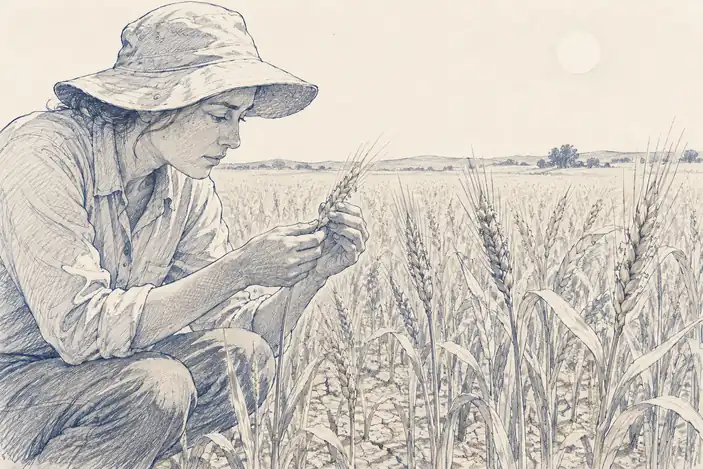
Process-based crop models such as DSSAT simulate development through phenological stages while accounting for weather, soil, water, management and cultivar characteristics. They do not predict yield by looking for a familiar image. They step a simplified plant through a season.
Timing is decisive. Heat or water stress during one developmental stage can matter far more than the same stress two weeks earlier. A seasonal rainfall total can therefore look normal while yield falls because the wrong weather arrived during flowering or grain filling.
The practical difficulty is parameterization. A global forecast cannot know every cultivar, sowing date, irrigation schedule or soil profile. Operational systems therefore mix crop models, weather forecasts, remote observations, field reports and statistical corrections. The plant is biological. The forecast is diplomatic.
SUPPLY AND MARKETS
Production is only the first forecast
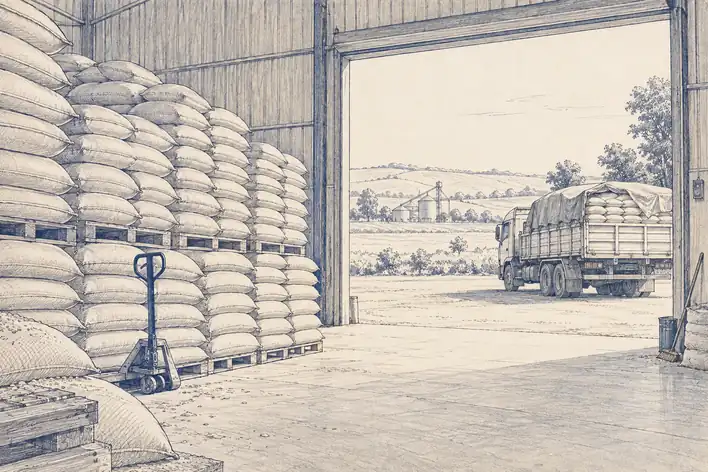
Once harvest enters storage, the problem becomes economic. A regional production shortfall can be absorbed by stocks or imports. A normal harvest can still coexist with rising food prices if currency weakens, transport costs rise or trade is disrupted. Tonnes of grain and access to food are related variables, not synonyms.
FAO's Global Information and Early Warning System reflects that structure. It monitors production, consumption, trade, prices and food-security conditions rather than treating crop output as the answer. Its Crop Prospects and Food Situation reports are explicitly forward-looking, while Food Outlook follows commodity markets and balances at global scale.
The forecast therefore becomes conditional. Given this production, these stocks, these import routes and these prices, what happens next? Change one border rule or shipping route and the biological forecast remains correct while the food outcome changes.
FOOD SECURITY
The last mile is not a plant model
Food-security systems have to estimate whether households can actually obtain food. That requires signals about prices, conflict, displacement, rainfall, vegetation, market access and sometimes survey data collected under difficult conditions. The farther the forecast moves from the field, the less physics can do for it.
This does not make the problem unmodelable. It changes the kind of forecast that is defensible. A weather model predicts from equations. A humanitarian early-warning system combines evidence and scenarios, updates frequently, and has to admit that a blockade or policy decision can invalidate yesterday's outlook in an afternoon.
The lesson is specific to prediction: a chain can be individually forecastable at every link and still be difficult to forecast end to end. The uncertainty does not merely add. It changes form as biology becomes logistics, logistics becomes economics, and economics becomes access.