COSMICS · CHAPTER 4.2
Why We Run the Future More Than Once
A single forecast hides how many plausible futures were available at the start.
EARTHVISION LAB · ~14 MIN READ
THE ACCIDENT
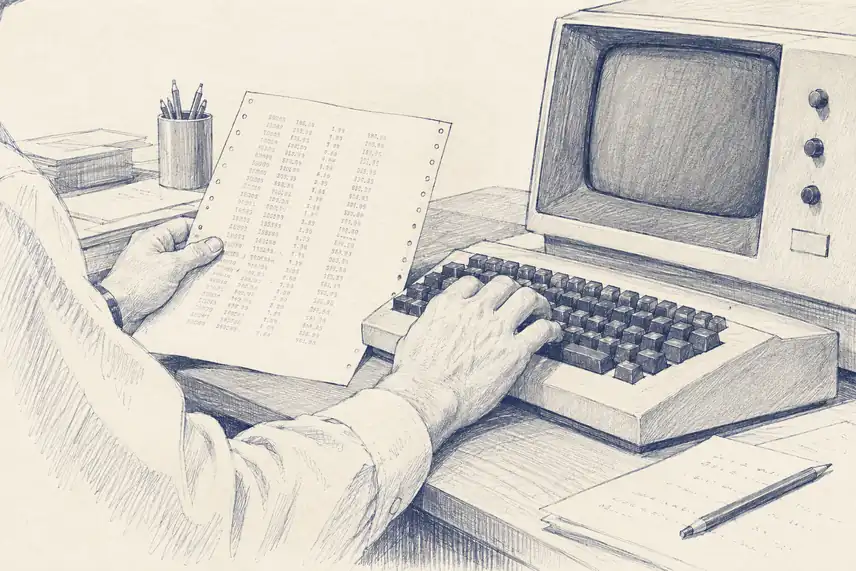
In the early 1960s, Edward Lorenz restarted a weather simulation by typing values from a printout back into his computer. The printout showed three decimal places while the machine had retained more. The new run followed the old one briefly, then wandered into a completely different weather history.
Nothing random had been added. The equations were the same. The difference was only in the starting state, smaller than any real observing network could ever measure perfectly. Lorenz had run into the practical problem of chaos: a deterministic system can become unpredictable because tiny initial errors grow.
CHAOS
Deterministic does not mean predictable
Lorenz formalized the result in his 1963 paper Deterministic Nonperiodic Flow. The distinction matters. If the exact initial state were known, the equations would return the same future every time. The difficulty is that the exact initial state is not knowable, and in a chaotic system the error does not stay politely small.
Weather therefore has a practical horizon for detailed deterministic prediction. Better observations and better models can push skill outward, but they cannot abolish sensitivity to initial conditions. The atmosphere has agreed to be governed by physics. It has not agreed to be conveniently forecast.
This is why two forecasts initialized from almost identical analyses can eventually disagree about the position of a storm. The disagreement is not automatically evidence that one model is broken. It may be evidence that the present state supports several futures that remain physically plausible.
ENSEMBLE PREDICTION
Run a family of plausible presents
Operational centres responded by running ensembles. Instead of one forecast from one estimated initial state, the system runs many forecasts with carefully perturbed starting conditions and, in some systems, perturbed model physics. Each member is a plausible future conditional on what is known now.
The spread among members is information. A tightly clustered ensemble says the current situation is comparatively constrained. A rapidly diverging ensemble says small uncertainties matter and confidence should fall. Probability products are then derived from the ensemble together with statistical calibration, rather than pretending one member is the future.
This distinction matters operationally. A cyclone track with a narrow probability envelope and one with a broad envelope may share the same most-likely line on a map, yet demand very different decisions. The line is easy to display. The uncertainty around it is the forecast.

THE LARGER LESSON
Uncertainty is part of the state
The same logic appears anywhere a forecast depends on an uncertain starting state, uncertain parameters, or several plausible scenarios. River forecasts use ensembles of rainfall and model states. Energy operators use probability distributions for wind and solar output. Crop and ecological projections increasingly run ensembles across weather, management and model assumptions.
The important change is conceptual. A forecast is not merely a value about the future. It is a distribution over futures conditioned on an imperfect present. Once that is accepted, uncertainty stops being an embarrassing footnote and becomes one of the main outputs of the system.