COSMICS · CHAPTER 4.7
Humans Change the Model While It Is Running
Dams, irrigation, roads, land use and policy rewrite the system a forecast thought it knew.
EARTHVISION LAB · ~14 MIN READ
STRUCTURAL CHANGE
A weather model can assume gravity will still work tomorrow. A river model cannot assume the river will still be operated tomorrow the way it was yesterday. Build a dam, pave a floodplain, expand irrigation or close a border and the physical laws remain intact while the forecast relationship changes.
This is a different failure mode from chaos. The initial state may be known perfectly and the equations may be correct, yet the model can still fail because the system it was calibrated on has been edited by people.
DAMS, IRRIGATION, CITIES
Infrastructure turns outcomes into operations
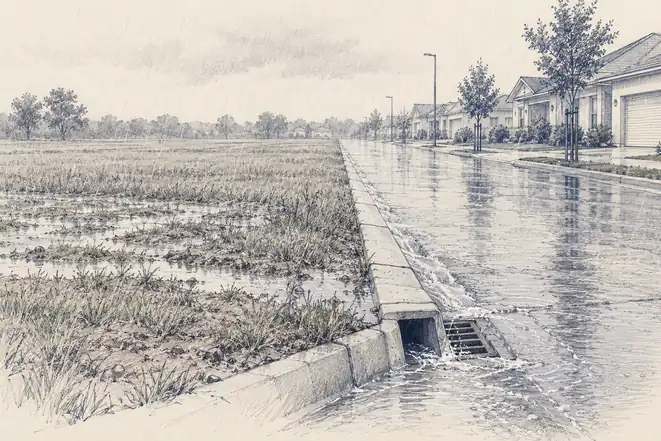
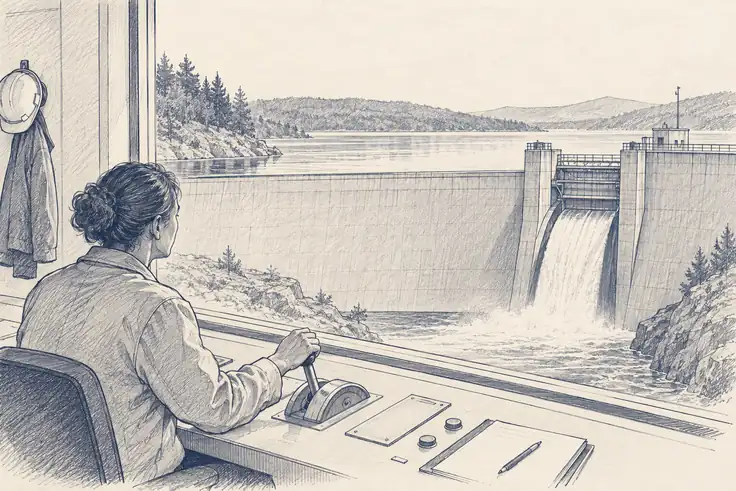
A reservoir converts downstream flow from a mostly hydrological outcome into a partly operational one. Rainfall and snowmelt still matter, but so do release rules, power demand, irrigation commitments and flood-storage decisions. A forecast that knows the catchment and not the operating policy is missing a control variable.
Irrigation alters the system more quietly. Pumping groundwater and applying it to fields changes soil moisture, evapotranspiration and sometimes local atmospheric conditions. Urbanization changes infiltration and runoff response. The land surface is not just being observed. It is being redesigned while the model is using yesterday's statistics.
Operational models therefore need updates that are not meteorological: reservoir schedules, land-cover change, withdrawals, network changes and management rules. Some of the most important forecast inputs are spreadsheets because institutions change faster than physical parameter sets.
CONDITIONAL FUTURES
When the future depends on a choice, forecast a scenario
Climate projections handle this explicitly. Future emissions, land use and socioeconomic development are not outputs of atmospheric physics, so modelers run scenarios instead. Shared Socioeconomic Pathways describe alternative trajectories of population, technology, land use and emissions, then physical models calculate the climate conditional on those assumptions.
The word conditional is doing important work. A projection under one pathway is not a claim that the pathway will occur. It says what the physical system is expected to do if that human trajectory occurs. Confusing a scenario with a forecast turns a transparent assumption into a false prediction.
The same logic applies to reservoirs, agriculture, energy systems and cities. If management decisions materially change the state, the honest model often produces a family of futures indexed by choices rather than one future pretending choices do not exist.
THE LIMIT OF PHYSICAL PREDICTION
Some variables are decisions
War, regulation, subsidies, trade restrictions and emergency responses can alter land use, movement, demand and supply on timescales shorter than many environmental forecasts. These are not hidden physical processes waiting for a better sensor. They are choices made by institutions and people.
Models can estimate the consequence of a decision far more reliably than they can predict the decision itself. If a port closes, freight can be rerouted. If a dam releases a given volume, downstream flow can be simulated. If emissions follow a pathway, climate response can be calculated. The conditional statement is the strength, not a weakness.
Prediction becomes most honest when it knows which variables are governed by physics and which are governed by somebody who may change their mind on Tuesday.