COSMICS · CHAPTER 6.4
Most Life Is Too Small to See
Microbes, fungi and environmental DNA reveal a biosphere whose largest catalogue still contains more unknowns than names.
EARTHVISION LAB · ~15 MIN READ
BIOLOGICAL SCALE
Earth observation is very good at seeing forests and almost completely incapable of seeing the organisms that make a gram of forest soil biologically active. Bacteria, archaea, fungi, protists and microscopic animals regulate decomposition, nutrient cycling, disease, symbiosis and carbon transformations at scales that do not present themselves as individual objects to an orbital sensor.
This is not the same blind spot as an animal hidden under a canopy. The organism may be physically exposed and still too small to resolve. Nor is it solved by a sharper image in any straightforward sense. Many microbes are distinguished by metabolism or genetics rather than appearance. The relevant property is not whether a dot can be photographed. It is what that organism is and what it is doing.
The result is a strange asymmetry. We can repeatedly map the colour and structure of ecosystems across continents while knowing far less about the microscopic communities doing much of the chemical work inside them. The planet is visible at landscape scale and crowded with biological dark matter underneath.
EARTH MICROBIOME PROJECT
The Earth Microbiome Project found novelty almost everywhere
The Earth Microbiome Project was built around a simple difficulty: microbial studies from different laboratories were hard to compare because sampling, extraction and sequencing protocols differed. The project coordinated standard methods across thousands of environmental samples so sequences from soil, sediment, water, plants, animals and built environments could be analysed in one framework.
Its first major global analysis included 27,751 samples from 43 countries and produced roughly 2.2 billion bacterial and archaeal 16S ribosomal RNA sequences. A Nature Reviews Microbiology summary noted that only about 10% of the sequences matched existing 16S reference databases at the time. Most of the sequence diversity therefore did not arrive with a familiar scientific name attached.
That number does not mean 90% of microbial species were newly discovered. A DNA sequence is not automatically a species, and marker genes have their own taxonomic limits. What it does show is how quickly environmental sampling outran the reference catalogues used to interpret it. We could detect biological variation more quickly than taxonomy could explain what produced it.
The project also demonstrates that invisible does not mean inaccessible. Microbes leave molecules that can be extracted, amplified and sequenced. The observing instrument is not a camera. It is a laboratory pipeline connected to a sampling design. To see a microbial planet, we first have to remove a small piece of it.
THE UNDESCRIBED MAJORITY
Fungi make the naming problem embarrassingly obvious
Fungi provide a more familiar version of the same problem. Royal Botanic Gardens, Kew estimated in its 2023 State of the World's Plants and Fungi work that Earth may contain about 2.5 million fungal species and that more than 90% were still unknown to science. At the contemporary rate of formal description, Kew noted, completing the catalogue would take close to a millennium.
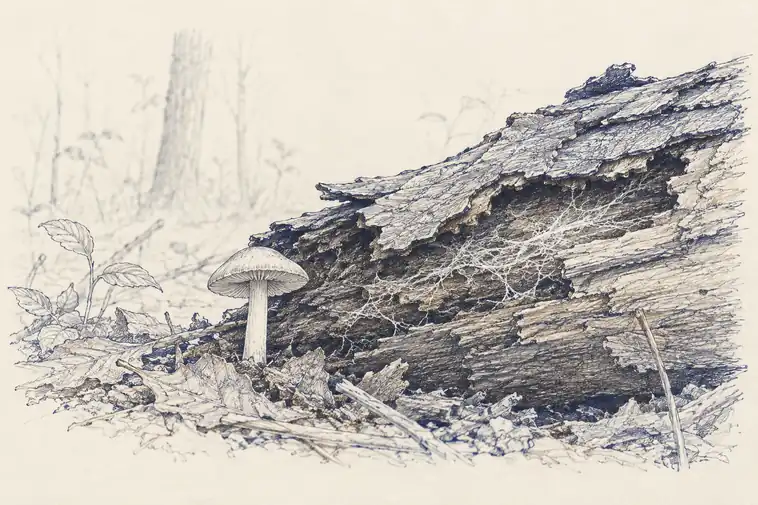
Many fungi spend most of their lives as microscopic filaments in soil, wood or living hosts. The mushroom is a reproductive structure, not the organism's full body. A forest can therefore contain an extensive fungal network without presenting a corresponding set of visible objects for a satellite, drone or field observer to count.
DNA sequencing reveals lineages that have never been cultured or formally described, but sequence databases inherit their own geography. Species from well-sampled regions and research institutions are easier to match than organisms from poorly sampled ecosystems. A reference library can only identify what somebody has already placed in the reference library.
This creates a different form of missingness from a blank map. The sample contains a signal. The pipeline detects it. The database returns unknown. The organism is not unseen because no evidence exists. It is unseen because the evidence has no agreed identity.
EDNA
Environmental DNA lets us sample an organism without meeting it
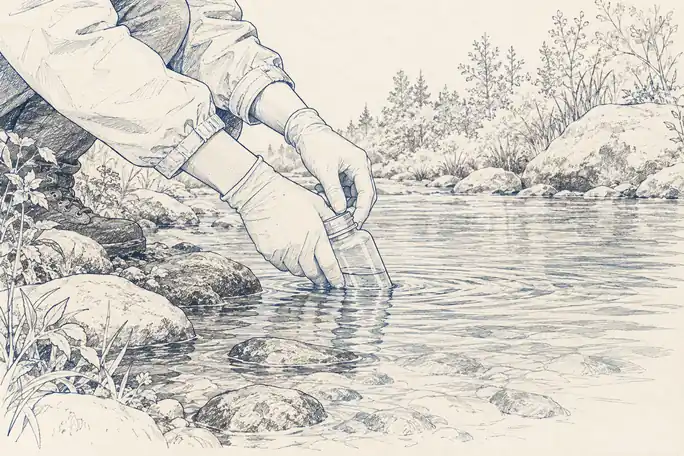
Environmental DNA extends the logic beyond microbes. Organisms shed genetic material into water, soil and air through skin cells, scales, mucus, pollen, faeces and other traces. Collect an environmental sample, extract the DNA and search for taxonomic markers, and a species can be detected without ever being photographed or captured.
USGS now uses eDNA for rare, cryptic and invasive species because the method can find organisms that conventional surveys miss. In aquatic systems, metabarcoding can process DNA from many taxa in one sample and reconstruct aspects of community composition. The sensor is effectively the environment itself, which has been collecting biological traces before the scientist arrives.
The method also introduces a new interpretation problem. DNA moves. Rivers transport it downstream. Wind moves pollen and airborne fragments. Molecules degrade at rates affected by temperature, ultraviolet exposure and chemistry. Detection therefore establishes that genetic material reached the sample, not necessarily that the living organism stood exactly at the sampling coordinate at that moment.
Reference databases remain a limiting step as well. A sequence that has no sufficiently close reference may remain taxonomically unresolved. A primer can amplify some groups better than others. Sampling can miss rare organisms. Molecular observation gives us access to a hidden biosphere and replaces visual blind spots with molecular ones.
FROM PRESENCE TO FUNCTION
Knowing who is present is not the same as knowing what the community is doing
A species list is only one layer of microbial and fungal ecology. Two soils can contain many of the same lineages while differing in which genes are active, which metabolites are being produced and which organisms are interacting. Metagenomics sequences genetic potential. Metatranscriptomics looks at expressed RNA. Metabolomics measures chemical products. Each asks a different question of the same invisible community.
This is why microscopic life belongs in a volume about observability rather than simply biodiversity. The difficulty is not merely that there are many species left to name. The relevant state can change without a visible landscape change at all. Nutrient cycling, pathogen activity and symbiosis can shift before canopy colour or productivity responds.
The most complete planetary observing system will therefore remain multi-scale by necessity. Satellites can identify where environmental conditions changed. Field samplers can retrieve the molecular evidence inside those places. Models can connect local biology to regional processes. None of the layers substitutes cleanly for the others.
A planet can be green from space while most of its biological conversations remain microscopic.