COSMICS · NOTE 002.9
When Observation Became an Industry
Launch got cheap enough that losing a satellite stopped being a catastrophe.
EARTHVISION LAB · ~15 MIN READ
THE COMMERCIAL PIVOT
In 1972, every satellite operator was a government, because only a government could absorb the cost of a launch failure. What changed by the 2010s was not that satellites got better. It was that a failed launch stopped being expensive enough to end a company.
THE COST COLLAPSE
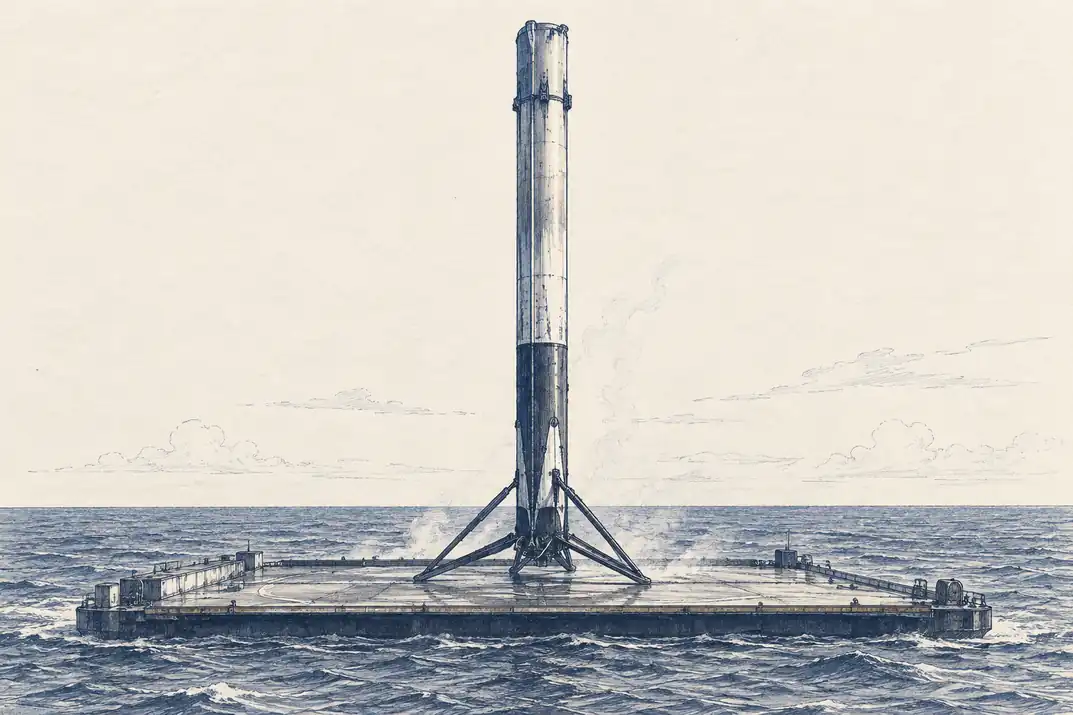
Reusable rockets moved the real cost off the launch pad
By 2009, SpaceX's Falcon 9 was pricing payload to low Earth orbit at around $2,700 per kilogram, a figure a 2018 NASA-funded analysis put at roughly $2,720 once independently recalculated. A dedicated Falcon 9 launch cost about $62 million in 2020, rising to around $74 million by early 2026 as inflation caught up with the price.
The number that mattered more for Earth observation was the rideshare price: by early 2026, a small satellite could book space on a Falcon 9 for around $350,000 for the first 50 kilograms, plus $7,000 for each additional kilogram to sun-synchronous orbit. That is a cost a company can absorb losing outright and still stay in business.
Booster reuse did most of the work. Reflying the same first stage instead of building a new one for every launch removed the single largest hardware cost from the equation, and higher flight rates spread whatever fixed costs remained across far more missions than any government program had ever flown in a comparable stretch of time.
THE DOVE MODEL
A company treated its own satellites as disposable by design
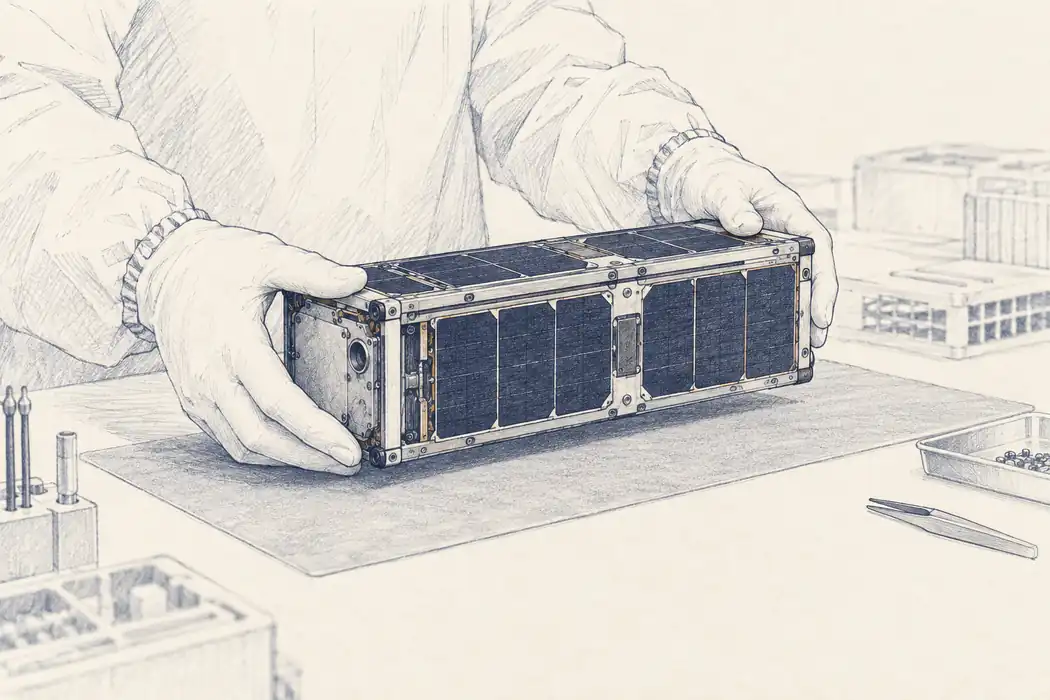
Planet Labs, founded in 2010 by three former NASA scientists, built Dove satellites deliberately small and deliberately cheap: 3U CubeSats, roughly the size of a loaf of bread, launched by the dozen. Flock-1, twenty-eight of them, deployed from the International Space Station in February 2014.
This was the direct consequence of cheap launch. A government mission that costs hundreds of millions of dollars cannot fail; every subsystem gets redundant backups and years of testing to prevent it. A Dove costing a small fraction of that can fail outright, and the constellation simply loses one satellite out of dozens rather than losing the mission.
That tolerance for individual failure is what let Planet iterate fast enough to hit Mission 1, daily imagery of Earth's entire land surface, by November 2017, six years after founding. No comparable government program, built around the assumption that each satellite has to work, has matched that pace from a standing start.
You can't fix what you can't see. We want to give people the tools to see change and take action.Will Marshall, co-founder, Planet Labs
THE OTHER BET
A parallel track spent the savings on precision instead of volume
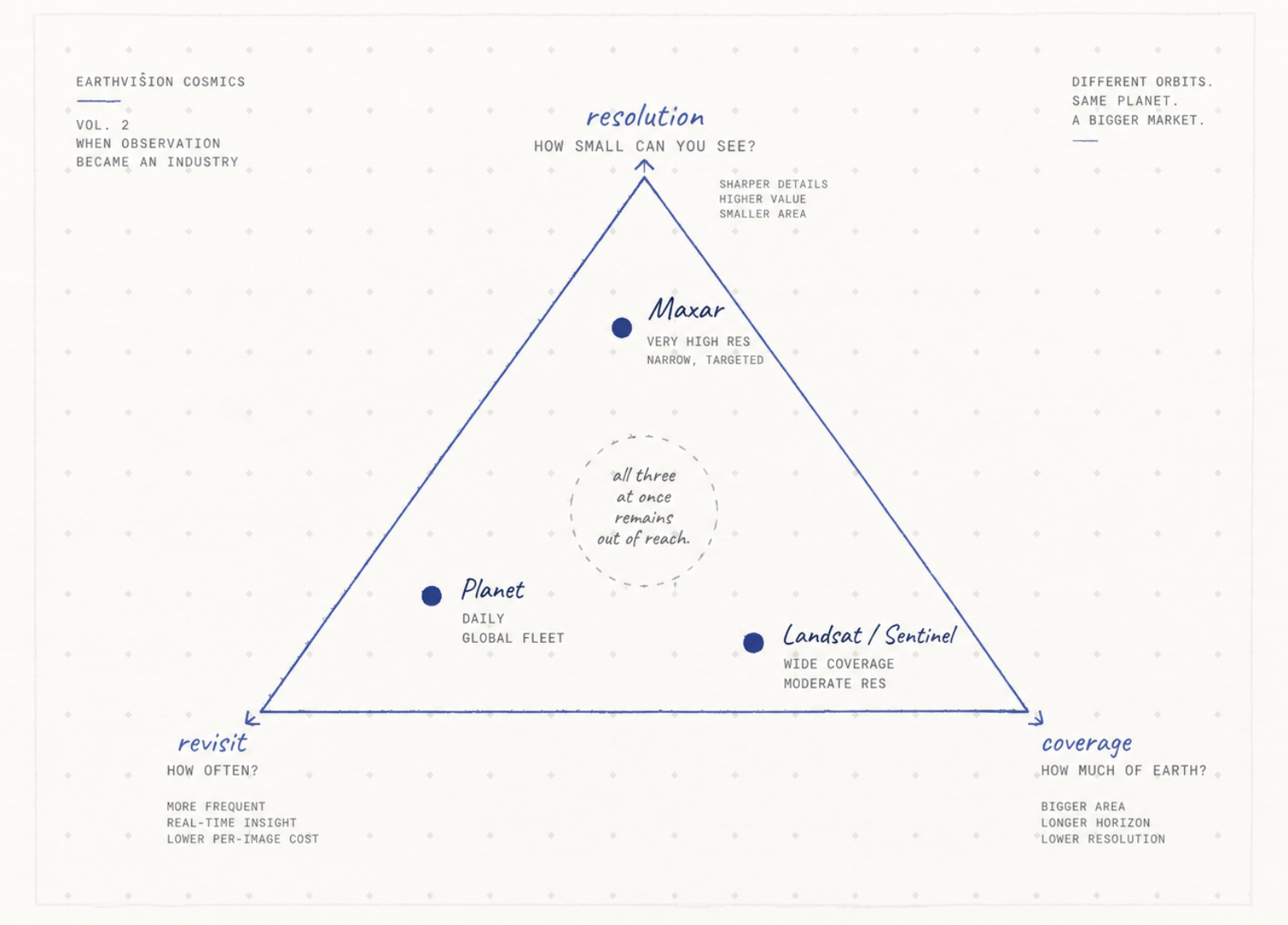
Not every commercial operator chased Planet's volume strategy. Maxar's lineage, from Ikonos in 1999 through four WorldView satellites launched between 2007 and 2016, kept building fewer, sharper, more expensive satellites rather than more numerous cheap ones.
WorldView Legion, a $600 million commitment begun in 2017, launched its first two satellites in May 2024, delivering 30-centimeter resolution imagery, precise enough to distinguish vehicle types from orbit. That is a strategy cheap launch enabled just as much as Planet's, only spent on capability per satellite rather than satellite count.
Two companies, same falling launch costs, opposite conclusions about what to build with the savings. Neither strategy made the other obsolete, because they were never actually competing for the same customer.
COMMERCIAL RADAR
Radar was miniaturized too, and sold as a subscription
Synthetic aperture radar had historically meant large, expensive government spacecraft, because generating and timing a radio pulse precisely enough takes power, antenna size, and orbital control that a small satellite struggled to carry. The Finnish company ICEYE broke that assumption on 12 January 2018, launching ICEYE-X1, a 70-kilogram SAR satellite, the first under 100 kilograms, on an Indian PSLV rocket.
By 2026, ICEYE had grown that single proof of concept into a fleet of more than 80 satellites, and two competitors, Capella Space and Umbra, built comparable micro-SAR businesses alongside it. In 2026 the U.S. National Reconnaissance Office selected all three for a commercial radar augmentation program, a government agency buying capacity from companies that did not exist a decade earlier rather than building the satellites itself.
A second commercial shift ran alongside the hardware: selling monitoring rather than images. BlackSky pairs a proliferated optical constellation with a software platform that promises assured revisit and rapid tasking rather than a file to download. The customer increasingly buys a subscription to a place being watched, not a satellite pass.
THE FRAGILITY QUESTION
The industry inherited speed and inherited fragility together
Government Earth observation is funded years ahead, with a replacement built before the current satellite fails, the model Landsat and NOAA both eventually returned to after Landsat's own commercialization scare in the 1980s. Commercial constellations answer to revenue instead, and revenue can fall short of a fleet's replacement cost regardless of how well the satellites themselves perform.
That is not a hypothetical risk. Planet and other commercial operators have gone through funding pressure and restructuring in the years since their founding booms, a reminder that a constellation's daily global coverage exists only as long as the business case behind it does.
The two systems are not actually substitutes for each other, whatever their marketing implies. A government archive with a fifty-year mandate and a commercial constellation optimized for this quarter's subscribers are solving different problems, and a planet that wants both continuity and speed currently has to fund both separately, because neither model has shown it can reliably deliver the other's strength.